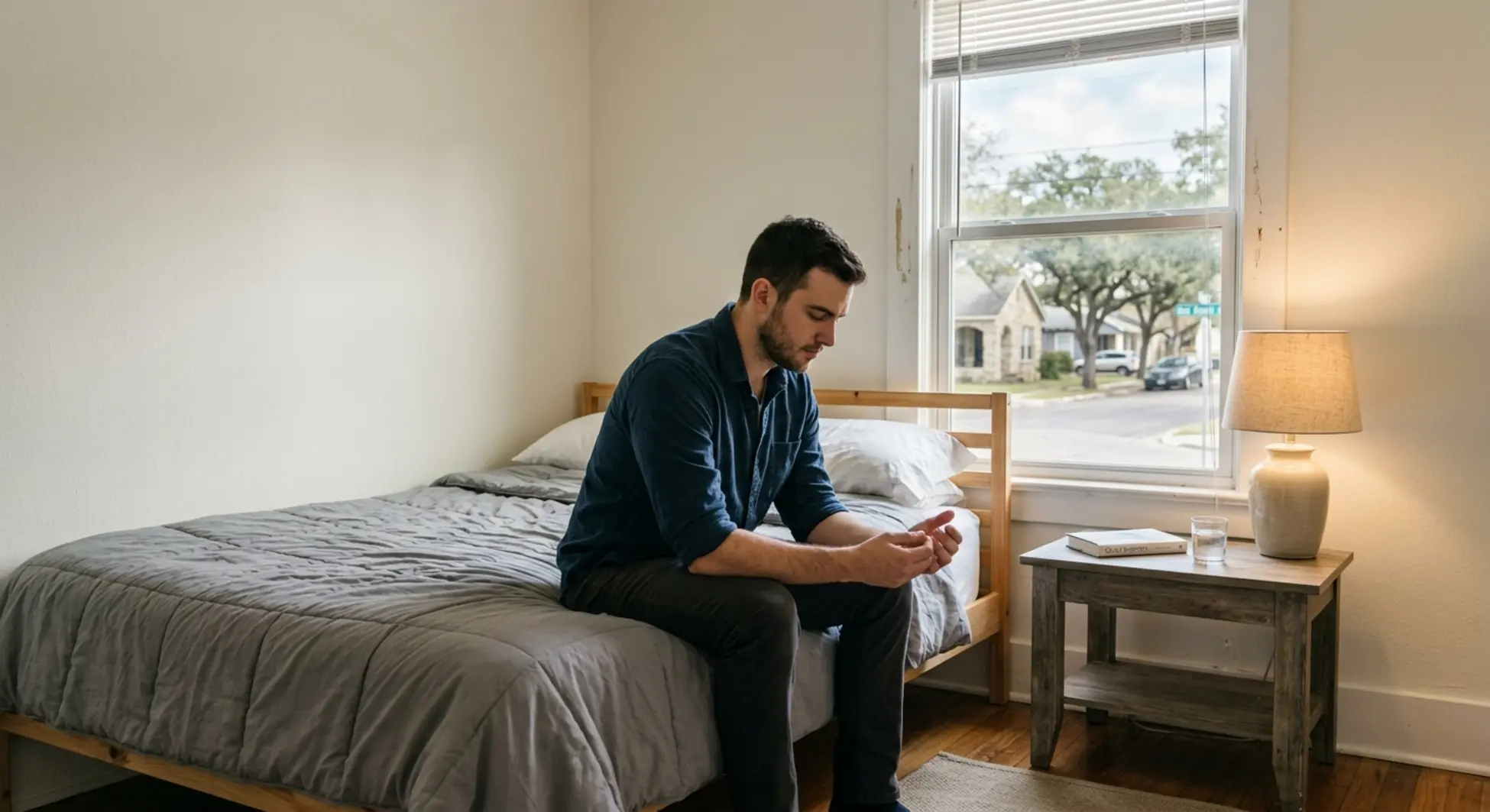
Three weeks out of treatment, sitting alone in his old apartment, a man stares at the ceiling and feels the full weight of what he’s just done. The structure of inpatient care — the scheduled meals, the group sessions, the counselors down the hall — is gone. The phone hasn’t rung. The old neighborhood is exactly the same. And the question that keeps circling back isn’t dramatic or philosophical. It’s simple and terrifying: Can I actually do this without someone holding the structure together? That gap — between the controlled environment of treatment and the unscripted reality of independent life — is where most relapse happens. It’s not a character flaw. It’s a design problem. And it’s exactly what structured sober living is built to solve.
This guide is for men in early recovery who are weighing whether sober living is the right next step, and for families trying to understand what real accountability looks like in practice. We’re going to walk through the specific relapse prevention measures that make structured sober living work — daily testing, employment requirements, brotherhood, financial literacy — and explain why they exist, how they function, and what they actually feel like to live inside. No scare tactics. No vague promises. Just straight information about how the bridge from treatment to independent life gets built, one day at a time.
If you’ve been wondering whether accountability means surveillance, whether structure means losing your freedom, or whether sober living is just a more expensive version of being alone — keep reading. The answers might surprise you.
Key Takeaways
- Research shows men who transition to structured sober living after treatment experience a 30–50% reduction in first-year relapse rates compared to those who return directly home or to less structured environments.
- Accountability measures like daily breathalyzer testing and drug testing every two weeks are designed to catch slips early and trigger support — not to punish residents for being human.
- The first 90 days after treatment discharge are the highest-risk window for relapse; structured sober living is specifically designed to close that gap.
- A strongly encouraged 30 hour work week, daily 12-step meeting attendance, financial literacy training, and house chores are all relapse prevention tools — not arbitrary rules.
- Research consistently shows that stays of 6–12 months in structured recovery housing predict significantly better long-term sobriety outcomes than 30–90 day stays.
- Brotherhood — other men in recovery noticing when you’re slipping and saying something — is one of the most powerful relapse prevention tools available, and it can’t be replicated by rules alone.
- A single relapse episode can cost $10,000–$50,000+ when factoring in re-treatment, medical care, legal issues, and lost income — making structured sober living one of the most cost-effective investments in recovery.
Why the First 90 Days After Treatment Are the Highest-Risk Window
Treatment does something remarkable. It creates a controlled environment where the chaos of active addiction gets interrupted — where a man can sleep without fear, eat regular meals, attend group sessions, and start to understand what drove him to use in the first place. The tools he builds there are real. The clarity he gains is genuine. But treatment is not real life. It’s a protected space designed to stabilize, not to simulate the full weight of independent living.
The moment a man walks out of inpatient care or completes an intensive outpatient program, he re-enters a world that hasn’t changed at all. The old neighborhood is still there. The people he used with are still there. The boredom, the financial stress, the isolation — all of it is waiting. And his brain, which has been healing in a structured environment for weeks or months, is suddenly asked to manage all of that without a safety net. According to data from NIDA and NARR research archives, men who transition from inpatient treatment directly to unstructured environments face dramatically higher relapse rates in that first year — with structured sober living showing a 30–50% reduction in relapse compared to less structured alternatives.
The top relapse triggers for men in early recovery aren’t mysterious. They’re isolation, boredom, idle time, returning to old environments, financial desperation, and emotional stress — anxiety, depression, anger — without the coping tools or support network to handle them. Treatment addresses these in a controlled setting. But the real test comes when the structure disappears. That’s the gap. And it’s exactly what a structured sober living environment is designed to close.
What Is the “Treatment Gap” and Why Does It Matter?
The treatment gap refers to the period between discharge from inpatient or intensive outpatient care and the establishment of stable, independent sober living. During this window, men face maximum exposure to relapse triggers with minimum structure and support. Sober living exists specifically to bridge this gap — providing accountability, community, and daily structure during the months when the risk of relapse is highest. It’s not a continuation of treatment. It’s the bridge between treatment and independent life.
The math here is straightforward, even if it’s uncomfortable to look at. A man who leaves treatment and goes home alone is betting that the tools he built in a controlled environment will hold up under the full pressure of real life — immediately, without a transition period, without peer support, without daily accountability. Some men make that work. Many don’t. Structured sober living isn’t an admission of weakness. It’s a recognition that the odds improve dramatically when you don’t have to white-knuckle it alone.
What Accountability Actually Means in Sober Living — It’s Not What You Think
Here’s the fear that stops a lot of men from considering sober living: they imagine a lockdown. A surveillance program. Someone watching their every move, ready to catch them slipping and throw them out. That fear is understandable — and it’s worth addressing directly, because it keeps men from choosing a resource that could genuinely change the trajectory of their recovery.
Accountability in a well-run sober living home means something specific: clear expectations, consistent consequences, and mutual support. It means you know exactly what’s required of you, you know what happens if you fall short, and you know that the people around you — residents and staff alike — are invested in helping you succeed. It does not mean surveillance. It does not mean shame. And it does not mean losing your identity as an adult.
We’re not running some high-security bunker where you feel like you’re being watched 24/7. You keep your phone. You choose your job. You live like an adult — because that’s exactly what you are. The accountability measures at Drew’s aren’t about catching you doing something wrong. They’re about building a track record of doing things right, one day at a time, until that track record becomes a foundation you can actually stand on.
Think of it less as “rules because we said so” and more as “let’s figure out how to be functional adults who remember to do dishes and show up for each other.” That’s the whole game. And it turns out, when you have a house full of men who are all playing that same game, something real starts to happen.
At Drew’s Sober Living, residents keep their personal phones and electronics, choose their own employment, and live as adults with autonomy and dignity. What they commit to is the program: daily breathalyzer testing, drug screening every two weeks, a strongly encouraged 30 hour work week, encouraged 12 step meetings, financial literacy training, and house chores. You can read the full details of how the program works — but the short version is this: the requirements exist because idle time, financial instability, isolation, and untreated stress are the enemies of early recovery. Every requirement is a direct counter to one of those enemies.
Daily Testing: How It Works and Why It Matters
Daily breathalyzer testing begins on day one — no exceptions, no grace periods, no “we’ll start next week.” This isn’t punitive. It’s protective. When a man knows he’ll be tested every single day, the mental calculus around using changes. The question stops being “will anyone find out?” and starts being “I know exactly what happens tomorrow morning.” That predictability is a powerful deterrent, and it removes a layer of temptation that would otherwise require enormous willpower to resist on its own.
Bi-weekly drug screening uses broad-panel tests that cover alcohol, opioids, stimulants, and other substances. Tests are observed and documented, creating a clear and verifiable record of sobriety. You can learn more about Drew’s drug testing program and exactly what it covers. The critical function of this testing isn’t just deterrence — it’s early detection. If a resident slips, a positive test means the response happens immediately: increased meetings, closer monitoring, group sessions, and a conversation about what triggered the slip. Early intervention prevents a slip from becoming a full relapse. That’s the whole point.
Structure That Prevents Relapse, Not Restricts Life
The strongly encouraged 30 hour work week — which kicks in after the 30-day probationary period — isn’t about keeping residents busy for the sake of it. Employment provides income, structure, purpose, and a daily reason to get up and show up. Financial instability is one of the most consistent relapse triggers for men in early recovery, and the work requirement directly addresses that by ensuring residents are building toward stability rather than sitting in financial anxiety.
During the probationary period — the first 30 days — the structure is tighter. A 10 PM weeknight curfew, 11 PM on weekends, no overnight passes, a 20-hour productivity requirement, and mandatory attendance at 12-step and in-house meetings. This isn’t punishment for being new. It’s recognition that the first month is when the risk is highest and the habits are still forming. As residents demonstrate responsibility and sustained sobriety, the structure adjusts accordingly. Curfews ease. Trust builds. The goal is always independence — the program is designed to get you there, not keep you dependent on it.
The Role of Brotherhood in Preventing Relapse
Rules alone don’t change anyone. You can have the most rigorous testing protocol in Texas, the most detailed house manual, the most carefully written set of expectations — and none of it will matter as much as a man who notices you’ve been quiet for three days and asks if you’re okay. That’s brotherhood. And it’s the relapse prevention tool that no rulebook can replicate.
Isolation is one of the top relapse triggers for men in early recovery — and it’s insidious because it can happen even when you’re surrounded by people. A man can be in a house full of other residents and still be completely alone inside his own head if the culture doesn’t support genuine connection. The difference between a house full of strangers following rules and a genuine brotherhood is the difference between compliance and recovery. Men in early recovery need both — the structure and the connection — because one without the other leaves a gap that relapse walks right through.
What does functional brotherhood actually look like? It’s the guy who’s been in the house six months helping the new resident find a meeting in his neighborhood. It’s someone noticing that a housemate skipped dinner and has been in his room all day — and saying something, not because it’s a rule, but because he’s been there and he knows what that silence usually means. It’s covering a chore for someone who’s having a hard week, and knowing that when your hard week comes, someone will return the favor. It’s shared experience creating mutual respect that doesn’t feel like judgment, because everyone in the house has been in the same place.
A strong peer culture reinforces recovery values and makes staying sober the norm rather than the exception. When the majority of the men around you are working their program, attending meetings, showing up to their jobs, and handling their responsibilities, that becomes the standard. Deviation from that standard gets noticed — not with shame, but with concern. That’s accountability that actually works, because it comes from people who understand exactly what you’re fighting.
The Difference Between Accountability and Punishment
This distinction matters enough to say plainly: accountability is not punishment. Punishment is reactive and backward-looking — you did something wrong, now you suffer the consequence. Accountability is forward-looking — here’s what’s expected, here’s what happens if you fall short, and here’s the support available to help you get back on track. The goal is never to catch a resident failing. The goal is to create conditions where failure is less likely, and where early slips get addressed before they become full relapses.
The Fear of Accountability Is Real — And It’s Worth Addressing
Many men worry that sober living will feel like a lockdown or a surveillance program. That fear makes sense — especially if your experience with authority has involved shame, punishment, or control. But here’s what accountability in a well-run sober living home actually produces: residents who report feeling safer and more supported, not trapped. The structure removes the constant low-grade anxiety of wondering whether you’ll make a good decision today. You already know what the day looks like. That predictability is a gift in early recovery, not a burden.
A positive test at Drew’s doesn’t mean immediate eviction. It means a conversation. It means increased meeting attendance, closer monitoring, and a group session to understand what happened and what support is needed. The first response to a slip is always to help the resident get back on track — because a slip that gets addressed immediately is a learning moment, not a failure. Repeated violations, or situations that create safety concerns for the house, may ultimately result in discharge. But the first instinct is always support, not punishment.
This approach is grounded in what research actually shows about recovery. Men who feel supported and respected during early recovery engage more fully with the process and maintain sobriety at higher rates than those who feel monitored and controlled. The accountability measures at Drew’s are designed to create the former, not the latter. Clear expectations, consistent consequences, and genuine investment in each resident’s success — that’s the formula.
Employment and Financial Stability as Relapse Prevention Tools
Financial stress is one of the most underappreciated relapse triggers in early recovery. A man who can’t pay his rent, who has no savings, who is watching debt accumulate while he tries to stay sober — that man is carrying a weight that makes every other aspect of recovery harder. The desperation that comes from financial instability isn’t just stressful. It’s a direct pathway back to using, because substances offer temporary relief from a kind of anxiety that feels impossible to escape.
The strongly encouraged 30 hour work week at Drew’s isn’t arbitrary. It’s a direct response to this reality. Employment provides income, but it also provides structure, purpose, and a daily reason to get up and function. Men who stay employed during their time in sober living build financial stability while simultaneously building the habits — showing up on time, following through on commitments, managing a schedule — that make independent living sustainable. Research consistently shows that men who remain employed during structured sober living have significantly higher rates of sustained sobriety long-term.
Beyond employment, financial literacy training is a core component of the program. Budgeting, savings, credit rebuilding — these aren’t extras. They’re essential recovery tools. A man who leaves sober living with a job, a savings account, and a basic understanding of how to manage money is in a fundamentally different position than one who leaves with only sobriety. The former has built a foundation. The latter is one financial crisis away from a relapse trigger he may not be equipped to handle.
Employment & Financial Requirements at Drew’s
- strongly encouraged 30 hour work week begins after the 30-day probationary period
- During probation: 20-hour weekly productivity requirement (work, volunteering, education, or job searching)
- Financial literacy training covers budgeting, savings strategies, and credit rebuilding
- Residents choose their own employment — Drew’s does not place residents in jobs
- Employment is viewed as a recovery tool, not just a financial necessity
Why Three to Twelve Months Matters More Than Thirty Days
Insurance companies and treatment centers often push for 30-day programs. That’s partly a coverage issue and partly a logistical one — but it’s worth understanding what the research actually says about length of stay, because the gap between what’s convenient and what’s effective is significant.
The Research on Length of Stay Is Clear
Studies consistently show that stays of 6–12 months in structured recovery housing predict significantly better long-term sobriety outcomes than shorter stays of 30–90 days. Men who stay 6–12 months show 2–3 times higher rates of sustained sobriety compared to those who leave after a month or two. Real change — building new habits, establishing employment, repairing relationships, developing a sober support network — takes longer than insurance covers. At Drew’s, there is no predetermined graduation date. Residents leave when they’re stable, not on a schedule.
Think about what actually needs to happen for a man to be ready for independent sober living. He needs stable employment. He needs a savings cushion. He needs a sober support network — people he can call at 10 PM when things get hard. He needs a sponsor and a working relationship with his 12-step community. He needs to have repaired at least some of the relationships damaged by active addiction. He needs to have developed the daily habits — waking up on time, managing money, handling conflict without using — that make sober life functional rather than just white-knuckled. None of that happens in 30 days. Most of it takes six months minimum.
The difference between short-term and long-term sober living stays isn’t just about time — it’s about what becomes possible when a man has enough time to actually build something. Three to six months is the recommended stay length at Drew’s. Three to twelve months is the typical range. The exit happens when the resident is ready, not when a calendar says so.
Common Relapse Triggers and How Structured Sober Living Addresses Each One
Relapse doesn’t usually happen because a man suddenly decides he wants to use again. It happens because a specific trigger — emotional, situational, social, or financial — creates a pressure that exceeds his current coping capacity. Understanding those triggers and having systems in place to counter them is the practical work of relapse prevention. Here’s how the structure of sober living addresses each major trigger directly.
| Relapse Trigger | How Structured Sober Living Counters It |
|---|---|
| Isolation and loneliness | Brotherhood and daily interaction with other residents; shared meals, chores, and activities create genuine connection |
| Boredom and idle time | 30-hour work requirement, daily 12-step meetings, house chores, and structured daily schedule eliminate the unstructured hours when risk spikes |
| Returning to old environments | Curfews and accountability keep residents engaged in recovery activities; new peer group replaces old social network |
| Emotional stress (anxiety, depression, anger) | Peer support, 12-step meetings, stable living environment, and house community provide a buffer; early detection through daily testing allows intervention before stress becomes crisis |
| Financial desperation | Employment requirement and financial literacy training build stability and reduce the anxiety that drives relapse |
| Peer pressure and old relationships | House rules and curfews create natural boundaries; brotherhood provides a new, sober peer group that replaces old using relationships |
What this table illustrates is that sober living isn’t a single intervention — it’s a layered system where each component addresses a specific vulnerability. Remove one layer and the system weakens. That’s why the requirements aren’t optional, and why the combination of testing, employment, meetings, brotherhood, and financial literacy training matters more than any single element on its own.
You can’t build a new life from your bed at 2:00 PM every afternoon. That’s not a judgment — it’s just physics. The structure at Drew’s isn’t designed to make your life harder. It’s designed to make it impossible to accidentally slide back into the patterns that led you here in the first place. When your day has shape — a job to get to, a meeting to attend, a chore to handle, brothers who notice if you don’t show up — the window for relapse gets a lot smaller. That’s the whole point.
What to Look for in a Sober Living Home: Red Flags and Green Flags
Not all sober living homes are created equal. The recovery housing landscape in San Antonio and New Braunfels — and across Texas — includes everything from rigorously accountable, NARR-certified programs to loosely run peer houses with minimal oversight, and unfortunately, some operators whose primary interest is profit rather than resident well-being. Choosing a sober living home is one of the most consequential decisions in early recovery, and it deserves careful evaluation.
The good news is that the difference between a legitimate, accountable program and a problematic one is usually visible if you know what questions to ask. Green flags include NARR certification, clear written policies, daily testing protocols, qualified staff oversight, transparent pricing with no hidden fees, and direct coordination with treatment centers. Red flags include vague answers about rules, lack of NARR certification, high resident turnover, overly permissive policies, excessive or unexplained fees, and any hint of patient brokering — the illegal practice of paying commissions for referrals.
Patient Brokering Is Illegal — And It Happens
Patient brokering — where a sober living operator pays commissions to individuals or organizations for referring residents — is illegal and a significant red flag. Legitimate operators focus on resident well-being and long-term recovery, not on filling beds through paid referrals. If a home is being aggressively marketed to you through a third party who seems financially motivated, ask hard questions about how they’re compensated.
Word-of-mouth from treatment centers and individuals in recovery is generally more reliable than online reviews alone. Treatment center discharge planners and case managers work with sober living homes regularly and know which ones actually deliver on their promises. If a home can’t provide references from treatment centers or doesn’t have a track record of working with clinical teams, that’s worth noting.
Questions to Ask Before Applying to a Sober Living Home
Walk into any sober living evaluation with specific questions. Vague answers to specific questions are a red flag. A well-run home will have clear, documented answers to all of the following — and staff who can answer them without hesitation.
Questions to Ask Any Sober Living Home Before You Apply
- “Are you NARR certified? What level?”
- “What is your drug and alcohol testing policy — frequency, type of tests, and how are they administered?”
- “What are the required daily activities — meetings, employment, chores?”
- “What happens if I relapse or test positive? Walk me through your protocol.”
- “What staff oversight is provided? Are there qualified house managers on-site?”
- “How long do residents typically stay? Is there a predetermined exit date?”
- “Can I work while living here? Is there a work requirement?”
- “Do you coordinate directly with treatment centers and clinical teams?”
- “What are all the costs — move-in fees, monthly rent, testing fees, and any other charges?”
You can also review frequently asked questions about Drew’s program to see what transparent answers to these questions actually look like in practice. Transparency about policies, pricing, and protocols is a baseline expectation — not a bonus feature.
Ready to Evaluate Whether Drew’s Is the Right Fit?
You’ve done the research. You know what questions to ask. Schedule a preliminary conversation with Drew to discuss your situation, ask anything you’re wondering about, and get honest answers about what the program looks like day-to-day. No pressure — just a real conversation about whether this is the right next step.
The Real Cost of Relapse vs. the Investment in Structured Sober Living
There’s a financial conversation worth having here, because cost is often one of the first objections to sober living — and it’s worth putting the numbers in context. Structured sober living in Texas typically runs $800–$1,500 per month for a mid-range program with staff oversight, daily testing, and structured programming. A six-month stay at that range totals $4,800–$9,000. That’s real money, and it’s fair to take it seriously.
The Economics of Relapse Are Stark
A single relapse episode — factoring in re-treatment costs ($5,000–$30,000+), emergency room visits ($1,000–$10,000+), potential legal costs, and lost income — can easily reach $10,000–$50,000 or more. That’s before accounting for the human cost: damaged relationships, lost employment, and the physical toll of returning to active addiction. Structured sober living, at $4,800–$9,000 for a six-month stay, with a documented 30–50% reduction in relapse rates, represents one of the clearest financial cases in recovery. It’s not an expense. It’s an investment in avoiding a far more expensive outcome.
It’s also worth noting that the cost of sober living in Texas varies significantly by program type and level of structure. Basic peer-run homes (Oxford House model) may run $500–$800/month with minimal oversight. Higher-support transitional housing with more intensive programming can reach $1,500–$3,000/month. The question isn’t just what you’re paying — it’s what you’re getting for that payment. Daily testing, qualified staff, a structured program, and genuine accountability are worth more than a cheap bed in a house with no oversight.
Insurance rarely covers sober living costs, since it’s typically classified as room and board rather than medical treatment. Some county programs in Bexar and Comal counties may offer assistance, and SAMHSA block grants distributed through TXHHS fund some subsidized recovery housing. If cost is a barrier, it’s worth asking directly — legitimate operators will be honest about what financial assistance options exist rather than hiding fees or making vague promises.
Medication-Assisted Treatment and Sober Living: What You Need to Know
If you’re on Suboxone, methadone, or another form of medication-assisted treatment (MAT) for opioid use disorder, the question of whether you’re welcome in sober living is one you need to ask directly — because policies vary significantly between homes, and finding out after you’ve applied is the wrong time to discover a mismatch.
MAT is a legitimate, evidence-based treatment for opioid use disorder. The science is clear: medications like buprenorphine and methadone reduce cravings, prevent withdrawal, and significantly lower the risk of overdose. Stigmatizing MAT — treating it as “not real recovery” — is both medically inaccurate and harmful. Many structured sober living homes, including programs that maintain rigorous accountability standards, permit residents on MAT if the medication is prescribed by a licensed physician and managed responsibly.
That said, some peer-run or more ideologically rigid programs do have restrictions on MAT. The key question isn’t your MAT status — it’s your commitment to recovery and your willingness to engage fully with the home’s accountability measures. If you’re on MAT and considering sober living, ask the question upfront: “What is your policy on medication-assisted treatment?” Any home worth considering will give you a clear, direct answer. Contact Drew’s directly to discuss your specific situation and get an honest answer about fit.
Building a Long-Term Recovery Plan Beyond Sober Living
Sober living is a bridge, not a destination. The goal of every day you spend in a structured recovery residence is to build the foundation that makes independent sober living not just possible, but sustainable. That means the habits you’re building — showing up on time, following through on commitments, asking for help when you need it, managing money, maintaining your meeting attendance — are the actual product of your time in sober living. The house is the environment. The habits are what you take with you.
The structure at Drew’s gradually reduces as residents demonstrate sustained sobriety and responsibility. Curfews ease. Autonomy increases. The probationary requirements give way to a more self-directed schedule as trust is established. This isn’t accidental — it’s designed to mirror the progression toward independent living, so that the transition out of sober living isn’t a cliff edge but a gradual handoff. A blueprint for recovery that works long-term is built on exactly this kind of incremental, earned independence.
Long-term recovery — the kind that holds up years after leaving sober living — requires ongoing engagement. Continued 12-step or alternative meeting attendance. A sponsor or accountability partner who knows your story. Employment that provides stability and purpose. A sober social network that doesn’t require white-knuckling every social situation. The men who maintain their meeting attendance and peer connections after leaving sober living have significantly higher rates of sustained sobriety than those who exit and go quiet. The community you build during your time in sober living is meant to travel with you.
Days 1–30: Probationary Period
Daily breathalyzer testing, 10 PM weeknight curfew, 11 PM weekends, no overnight passes, 20-hour productivity requirement, mandatory 12-step and in-house meetings. Find a sponsor and begin working steps.
Months 1–3: Building the Foundation
30-hour work requirement begins. Curfews adjust based on demonstrated responsibility. Financial literacy training continues. Brotherhood deepens as trust builds within the house community.
Months 3–6: Recommended Stay Length
Employment stable, savings building, sober support network established. Sponsor relationship active. Daily habits — showing up, following through, managing money — becoming second nature.
Months 6–12: Exit When Ready, Not on a Schedule
No predetermined graduation date. Residents leave when stable employment, finances, sober support network, and demonstrated readiness exist. The transition to independent living is a handoff, not a cliff.
If you’re a family member trying to understand what this process looks like from the outside, the resources for families at Drew’s can help you understand the program, what to expect, and how to support your loved one without enabling. Recovery is a family process as much as an individual one, and understanding what structured sober living actually provides — and what it doesn’t — is part of being a useful support.
Frequently Asked Questions
What happens if I relapse while living in a sober home?
Policies vary by home, but structured residences like Drew’s have clear protocols. A positive test typically triggers increased support — more meetings, closer monitoring, group sessions — rather than immediate discharge. The goal is accountability and support to return to sobriety, not punishment for being human. Repeated violations or situations that create safety concerns for the house may ultimately result in discharge, but the first response is always to help you get back on track. A slip addressed immediately is a learning moment, not a failure.
Do accountability measures in sober living homes feel too strict or punitive?
Accountability measures like daily testing and curfews are designed to create a safe, supportive environment that promotes recovery — not to punish residents for needing structure. While they require discipline, most residents find these structures genuinely beneficial: they reduce the temptation to use, create predictability in a period of life that often feels chaotic, and help rebuild trust with yourself and others. The structure is tightest in the first 30 days and adjusts as you demonstrate responsibility. By the time you’re several months in, the structure feels less like a cage and more like a scaffold you built yourself.
How does daily drug testing actually work in a sober living home?
Daily testing typically involves observed breathalyzer tests administered by staff or a house manager — beginning on day one, with no exceptions. Bi-weekly drug screening uses broad-panel urine analysis that covers alcohol, opioids, stimulants, and other substances. Tests are observed and documented, creating a verifiable record of sobriety. The purpose isn’t to catch residents failing — it’s to remove the mental calculus around using and to ensure that any slip gets detected and addressed immediately rather than allowed to escalate into a full relapse. You can learn more about the specifics of Drew’s drug testing program on the program page.
How important is the peer community in sober living for relapse prevention?
The peer community is one of the most powerful relapse prevention tools available — and it’s the one that can’t be replicated by rules alone. Shared experience and mutual support provide encouragement, accountability, and a sense of belonging that directly counters isolation, which is one of the top relapse triggers for men in early recovery. A strong peer culture makes staying sober the norm rather than the exception. Other residents noticing when you’re struggling and saying something — not out of obligation, but out of genuine brotherhood — is accountability that actually works because it comes from people who understand exactly what you’re fighting.
Can I stay in a sober living home if I’m on medication like Suboxone or Methadone?
Policies vary between homes, and it’s critical to ask directly before applying. Many structured sober living homes permit residents on MAT (Medication-Assisted Treatment) if the medication is prescribed by a licensed physician and managed responsibly — and MAT is a legitimate, evidence-based treatment for opioid use disorder that should not be stigmatized. Some peer-run or more ideologically rigid programs may have restrictions. Always clarify the home’s MAT policy prior to admission — it’s one of the most important questions to ask during your evaluation process.
Does the strict structure of sober living hurt long-term independence?
Structured sober living is designed as a transitional step, not a permanent state. The structure gradually reduces as residents demonstrate sustained sobriety and responsibility — curfews ease, autonomy increases, and the program evolves to mirror the progression toward independent living. The habits built during structured sober living — showing up on time, managing money, maintaining meeting attendance, asking for help — are the foundation for lasting independence, not a substitute for it. Residents leave when they’re stable and ready, not on a predetermined schedule, which means the exit is earned rather than imposed.
The man who sat alone in his old apartment three weeks out of treatment — wondering if he could actually do this — didn’t fail because he was weak. He was in a situation designed to produce failure: maximum exposure to triggers, minimum structure and support, and the impossible expectation that the tools built in a controlled environment would hold up under full real-world pressure immediately. That’s not a character flaw. That’s a gap in the system.
Structured sober living closes that gap. Not with surveillance or shame, but with daily accountability, genuine brotherhood, employment that builds stability, and enough time — three to twelve months — for real change to take root. The men who come through Drew’s Sober Living in San Antonio and New Braunfels don’t leave because a calendar said it was time. They leave because they’ve built something: a job, a savings account, a sponsor, a sober network, a set of habits that hold up under pressure. They leave ready.
You don’t have to do it alone. That’s not weakness — that’s wisdom.
Ready to Explore Sober Living as Your Next Step?
If you’re in early recovery and considering sober living — or if you’re a family member looking for the right environment for your loved one — we’re here to listen and help. Drew’s Sober Living operates three structured men’s recovery residences in San Antonio and New Braunfels, each built on daily accountability, brotherhood, and the belief that real change takes time. There’s no pressure — just honest conversation about what recovery can look like.
Drew’s Sober Living · Men’s Recovery Residences in San Antonio & New Braunfels, TX