Key Takeaways
- Online addiction counseling in Texas costs $240–$400/month on subscription platforms like BetterHelp and Talkspace, or $100–$250 per session with a licensed LCDC or LPC without insurance — free and sliding-scale options also exist through SAMHSA and Open Path Collective.
- Texas Medicaid increasingly covers telehealth addiction counseling, but provider networks are limited — always verify directly with your plan and the counselor before your first session.
- Men who combine structured sober living with online counseling have relapse rates of 20–40%, compared to 40–90% for those with no structured support after treatment — the combination is the evidence-based gold standard.
- Always verify a Texas counselor’s license (LCDC, LPC, or LCSW) through the Texas Behavioral Health Executive Council at bhec.texas.gov before committing to any provider or platform.
- Trust Drew’s Sober Living for daily accountability, structured recovery housing, and a real brotherhood that bridges treatment and independent life — visit Drew’s Sober Living to learn how sober living fits into your recovery plan.
How Much Does Online Addiction Counseling Cost in Texas in 2026?
Online addiction counseling in Texas ranges from $240–$400 per month for subscription platforms like BetterHelp, to $100–$250 per session for licensed counselors without insurance. Free and low-cost options exist through state-funded programs and sliding-scale providers. The real question isn’t just the sticker price — it’s whether online counseling alone is enough, or whether combining it with structured sober living offers better long-term outcomes.
Let’s break down what you’ll actually pay, what’s covered by insurance, and how to evaluate whether online counseling fits your recovery plan.
Drews Sober Living
Daily Breathalyzer Testing for Every Resident
Core Service Programs:
- Structured Sober Living Homes for men transitioning from treatment to independent, sober living
- Daily Accountability & Drug Testing for residents and families who need consistent, verifiable structure
- Life-Skills & Employment Readiness for men rebuilding work history, finances, and a sober support network
Why Choose Drews Sober Living:
- ✓ Trusted by customers with a perfect 5.0-star Google rating across 91 verified reviews
- ✓ Daily breathalyzer testing for every resident, plus drug testing every two weeks
- ✓ Four operating houses, 38 beds in San Antonio and New Braunfels, Divine House coming soon
- ✓ Live in house managers who are men in long term recovery themselves
- ✓ Founded in 2023 by Drew, who built every house policy from his own recovery
- ✓ 83% of residents who moved out of the community did so sober
- ✓ Strongly encouraged 30 hour work week plus financial literacy and life skills training
Subscription-Based Online Counseling Platforms: The Most Affordable Entry Point
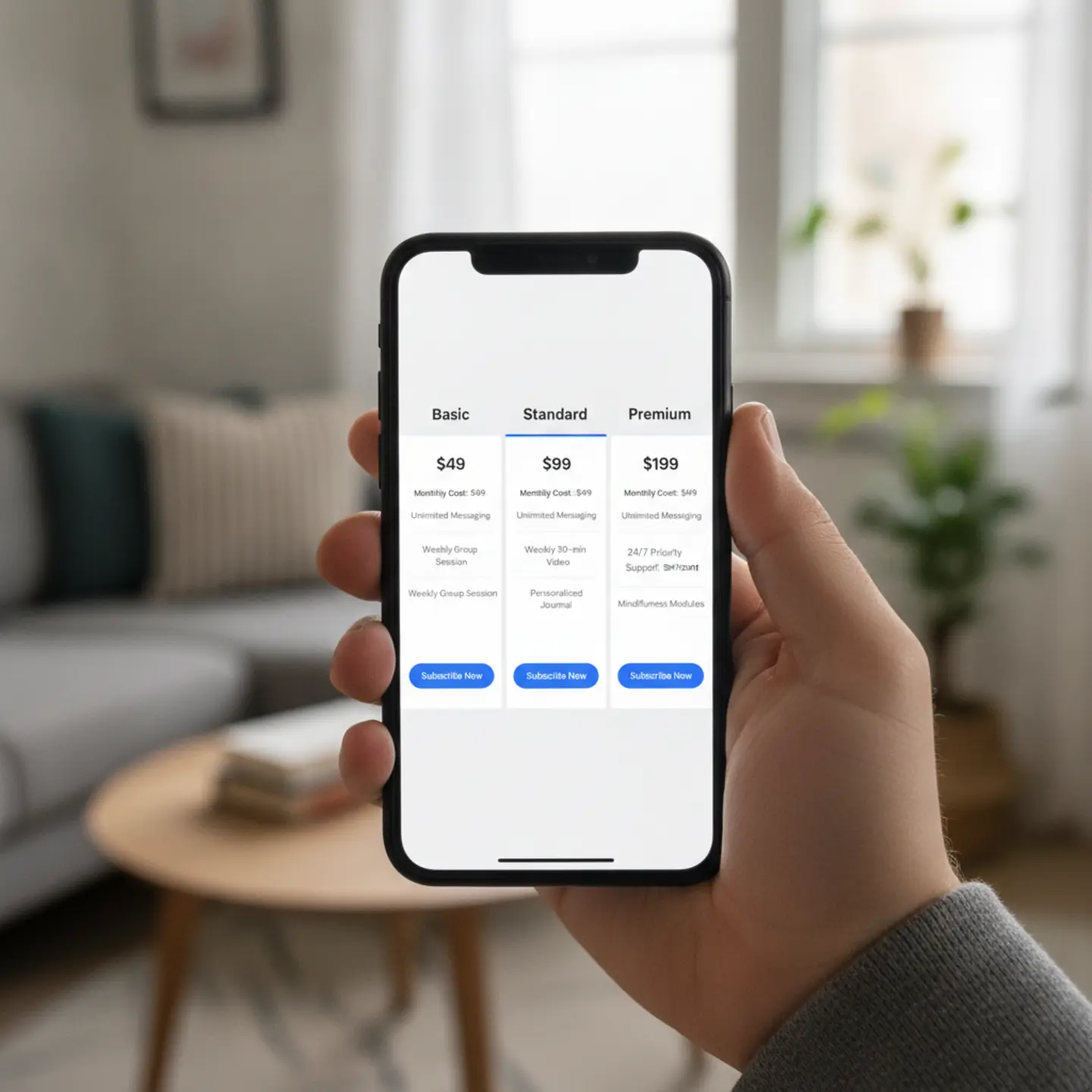
If you’re just starting to look at online counseling options, subscription platforms are usually the first thing that comes up — and for good reason. BetterHelp and Talkspace both charge $60–$100 per week (roughly $240–$400 per month), which typically includes unlimited text-based messaging with your therapist plus one to four live video or phone sessions monthly depending on your plan tier. That per-session cost, when you do the math, often beats what you’d pay out-of-pocket for a single appointment with a private practice therapist.
Cost Anxiety Is Real — But You Have Options
If you’re worried about affording counseling or sober living, know that you’re not alone and that cost should never be a barrier to seeking help. Free and low-cost options exist, and many providers work with you on payment plans. SAMHSA’s National Helpline (1-800-662-4357) is free, confidential, and available 24/7.
What’s Included in a Typical Subscription
Most subscription plans include unlimited asynchronous messaging — meaning you can write to your therapist between sessions and they’ll respond within a business day or two. You also get one to four live sessions per month via video or phone, access to a matched therapist through the platform’s app, and the ability to switch providers if the fit isn’t right (though that process can involve delays). The mobile-first design makes it easy to fit therapy into a work schedule or a structured sober living routine.
Pros and Cons of Subscription Platforms for Addiction Counseling
The upside is real: lower cost per session, no long-term contract, and the flexibility to communicate on your own schedule. The downside is equally real. Not every therapist on these platforms specializes in substance use disorders — addiction expertise varies widely by provider, and you’ll need to vet that yourself. Crisis protocols can also be limited compared to a dedicated addiction specialist. And the subscription keeps billing even during weeks you’re not actively using it, so factor that into your budget.
Here’s the honest truth about subscription platforms: they’re a solid starting point, but “matched with a therapist” doesn’t automatically mean “matched with someone who understands addiction.” When you’re evaluating any counselor on these platforms, ask directly — what’s your experience with substance use disorders? If they hedge or pivot, keep looking. You deserve someone who actually knows this territory.
Per-Session Online Counseling from Licensed Addiction Specialists: Higher Cost, Deeper Expertise
Working directly with a licensed addiction counselor — an LCDC (Licensed Chemical Dependency Counselor), LPC, or LCSW with documented addiction experience — costs more upfront but delivers a level of specialization that subscription platforms can’t guarantee. Per-session rates run $100–$250 for a 45–60 minute session without insurance, and in San Antonio, comparable in-person sessions often run $120–$300, so telehealth can represent a 10–30% savings while giving you access to the same clinical quality.
What Makes a Licensed Addiction Counselor Worth the Cost
The LCDC credential is the one to look for. It requires specialized education and supervised clinical hours specifically in chemical dependency counseling — not just general mental health training. An LCDC understands the pharmacology of addiction, evidence-based relapse prevention models, and how to coordinate with treatment teams and sober living programs. An LPC or LCSW with documented addiction experience and trauma-informed training can also provide excellent dual-diagnosis care, particularly if co-occurring PTSD or anxiety is part of your picture. The continuity of working with one counselor over months — someone who knows your history — is something no platform algorithm can replicate.
How to Find Affordable Licensed Counselors
Open Path Collective offers sliding-scale rates of $30–$80 per session for licensed therapists, with income verification required. Psychology Today and Zocdoc both allow you to filter by insurance acceptance and addiction specialization. One often-overlooked move: ask prospective counselors directly about their self-pay rate. Many licensed therapists set self-pay rates lower than what they bill insurance, and that number isn’t always advertised. You can also find referrals through your treatment center’s discharge planner — those relationships tend to produce the best therapist-client fit because the counselor already understands your clinical context. For a detailed comparison of the major platforms, the BetterHelp vs. Talkspace addiction counseling breakdown covers the key differences side by side.
Insurance Coverage and Out-of-Pocket Costs: What Texas Medicaid and Commercial Plans Actually Cover
Insurance coverage sounds straightforward until you’re actually trying to use it. The short version: most major commercial plans and Texas Medicaid cover online addiction counseling, but your real out-of-pocket cost depends heavily on your specific plan, your deductible status, and whether your chosen provider is in-network.
Texas Medicaid and CHIP Coverage
Texas Medicaid coverage for telehealth mental health and addiction counseling has expanded significantly since 2020, but it varies by managed care plan — and many providers simply don’t accept Medicaid. Before you book a single session, call your plan and ask two questions: Is this specific provider in my network? And is telehealth addiction counseling a covered benefit under my plan? If the answer to either is no, you’ll need to look at state-funded alternatives or out-of-pocket options. Your Local Mental Health Authority (LMHA) is the right starting point — in Bexar County, the Center for Health Care Services (CHCS) offers state-funded substance abuse services for uninsured and underinsured residents.
Commercial Insurance Realities
Major carriers — Aetna, Cigna, Blue Cross Blue Shield, UnitedHealthcare — typically cover online addiction counseling at the same rate as in-person sessions when the provider is in-network. Co-pays generally run $30–$60 per session. The catch is the deductible: most commercial plans carry deductibles of $1,000–$5,000, and until you’ve hit that number, you’re paying the full negotiated rate out-of-pocket. Out-of-network providers may require full payment upfront, with reimbursement only after you submit claims manually. Budget accordingly, especially in the first few months of the year when deductibles reset.
How to Verify a Texas Counselor’s License
Go to bhec.texas.gov and use the online license search tool. Select the appropriate board, enter the counselor’s name or license number, and the results will show their license status, expiration date, and any disciplinary actions. This takes about two minutes and should be non-negotiable before your first session with any provider.
Free and Low-Cost Addiction Counseling Options in Texas: Don’t Overlook These
Cost should never be the reason someone doesn’t get help. Texas has real free and low-cost options — they just require some legwork to find. SAMHSA’s National Helpline (1-800-662-4357) provides free, confidential referrals to local treatment and support services 24 hours a day, seven days a week. It’s one of the most underused resources in recovery, and it costs nothing to call.
State-Funded Programs Through Your Local Mental Health Authority
In Bexar County, CHCS offers state-funded substance abuse services that may include subsidized counseling for uninsured or underinsured residents. Comal County is served by a different LMHA — contact your county health department for the right referral. These programs often have waitlists, but they provide legitimate, licensed clinical care. If you’re in a sober living program while you wait, that structure keeps you stable in the meantime.
Peer Support and Group Counseling (Often Free or Very Low Cost)
Twelve-step meetings — AA, NA, and SMART Recovery — are free and widely available across San Antonio and New Braunfels. Peer recovery support groups and community health centers may also offer free or donation-based group counseling. Peer support doesn’t replace clinical therapy, but the research is consistent: men who combine peer community with professional counseling do better than those who rely on either alone. That’s also the logic behind why sober living works — the brotherhood is doing real clinical work, even if no one in the house has a license.
Figuring Out Which Counseling Option Fits Your Recovery Plan?
You don’t have to sort through this alone. Drew’s Sober Living works alongside online counseling providers and can help you think through how structured housing fits into your overall recovery plan — including cost.
Online Counseling vs. Sober Living vs. Both: Cost Comparison and Outcomes
This is the section most people skip to, and it’s the one that matters most. The financial question and the clinical question are the same question: what combination of support gives you the best shot at long-term sobriety, and what does it actually cost?
Combine Counseling and Sober Living for Maximum Impact
While the combined cost is higher upfront (~$740–$2,900+/month), research shows that men who combine online counseling with structured sober living have dramatically lower relapse rates and better long-term outcomes. According to SAMHSA data, relapse rates drop to 20–40% with both in place — compared to 40–90% with no structured support. Think of it as an investment in your future, not just an expense.
| Support Model | Monthly Cost Range | What It Provides | First-Year Relapse Rate |
|---|---|---|---|
| No structured support | $0 | Nothing beyond willpower | 70–90% |
| Online counseling only | $240–$400/mo (subscription) or $400–$1,000/mo (per-session) | Clinical therapy, MAT coordination, relapse prevention | 40–60% |
| Sober living only | $500–$2,500/mo | Accountability, structure, peer community, drug-free environment | 30–50% |
| Online counseling + sober living | $740–$2,900+/mo | Clinical support + daily accountability + peer brotherhood | 20–40% |
Online Counseling Alone: Best For
Men with stable housing, a strong peer support network already in place, reliable employment, and financial stability. If you’re managing co-occurring mental health conditions that require ongoing therapy, online counseling is an essential tool. But without the physical accountability of daily testing and a drug-free environment, the first-year relapse rate sits at 40–60% — and that number climbs fast for men coming directly out of intensive treatment with no transition structure.
Sober Living Alone: Best For
Men who need daily accountability, structure, and a drug-free peer community but may not yet have consistent access to clinical care. Sober living addresses the environmental and behavioral side of recovery — getting up, going to work, showing up to meetings, being accountable to the men around you. First-year relapse rates drop to 30–50% with sober living alone. Add counseling, and that number drops further.
Combining Online Counseling and Sober Living: The Gold Standard
Sober living provides the structure; online counseling addresses the underlying trauma, mental health conditions, and relapse triggers that structure alone can’t touch. The combination is what the research consistently points to — relapse rates in the 20–40% range, higher rates of employment, and reduced criminal justice involvement compared to either model alone. The higher monthly cost is real, but so is the cost of a relapse: rehospitalization runs 2–3 times more likely without ongoing support, and that’s before you factor in lost wages, legal involvement, and the personal cost of starting over. For more on how transitional housing fits into the picture after treatment, the guide to transitional housing after 30-day rehab covers the accountability gap in detail.
Top 5 Online Addiction Counseling Platforms and Providers Serving Texas Men
Not all platforms are built the same, and not all of them are built for addiction. Here’s an honest look at the five most relevant options for men in recovery in Texas, with the key details you need to evaluate each one.
Red Flags When Choosing an Online Counselor
Avoid counselors who can’t provide a Texas license number, claim to “cure” addiction, refuse to coordinate with your sober living or treatment team, or have vague fee structures. These are signs of inexperience or predatory practices. Unqualified “coaches” marketing themselves as therapists are a real problem in this space — always verify the license at bhec.texas.gov before committing.
| Provider | Cost | Addiction Expertise | Best For |
|---|---|---|---|
| BetterHelp | $240–$400/mo (subscription) | Variable — not all therapists specialize in SUD | Affordable entry into online therapy; general mental health focus |
| Talkspace | $260–$400/mo (subscription) | Moderate — some SUD specialists; psychiatry available | Men who may need medication management alongside therapy |
| Workit Health | $150–$300/mo for therapy; MAT billed separately | Highest — all providers specialize in OUD and AUD | Men with opioid or alcohol use disorder needing integrated, specialized care |
| Open Path Collective | $30–$80/session (sliding scale, income verification required) | Varies — many have addiction training; requires direct inquiry | Men with limited income or no insurance; pay-as-you-go flexibility |
| Solo LCDC/LPC via Telehealth | $100–$250/session without insurance | Highest — LCDC credential ensures specialized SUD training | Men seeking a deep, ongoing therapeutic relationship with an addiction specialist |
Regardless of which option you choose, verify Texas licensure before your first session. For LPCs, Texas joined the Counseling Compact in 2025, which allows compact-member-state licensees to practice remotely in Texas — but this applies to LPCs, not necessarily LCDCs. When in doubt, run the license number through bhec.texas.gov. For a deeper dive into how the top platforms compare on addiction-specific features, the 2026 online addiction counseling platform review covers each one in detail.
Why Drew’s Sober Living Is the Right Choice for San Antonio and New Braunfels Men in Recovery
Online addiction counseling is essential — it addresses the clinical side of recovery that sober living can’t and shouldn’t try to replace. But clinical support alone doesn’t keep you sober at 10 PM on a Tuesday when the house is quiet and the old thinking starts. That’s where structured sober living does its work.
Drew’s Sober Living has four operating houses, 38 beds — Chittim House in North San Antonio, Evergreen House in Central San Antonio, and Chapel Bend in New Braunfels — with 27 beds total. Founded in 2023 by Drew, who built every house policy from his own recovery, DSL runs the same program across all three locations: daily drug and alcohol testing from day one, drug testing every two weeks, a strongly encouraged 30 hour work week after probation, encouraged 12 step meeting attendance, and financial literacy training. These aren’t rules for the sake of rules. They’re the daily reps that build a life.
A perfect 5.0-star Google rating across 91 verified reviews and an 83% move-out-sober rate aren’t marketing numbers — they’re the result of combining clinical support with real-world accountability and a brotherhood that holds men to a standard. Drew’s doesn’t provide therapy or clinical services, and that’s by design. The goal is to be the structure that makes your online counseling actually work — the environment where the clinical insights you gain in sessions have a chance to take root in daily life.
Schedule a call with Drew’s Sober Living today — we’ll help you understand how sober living fits into your recovery plan, answer any questions about cost and program requirements, and talk through how we coordinate with your online counseling provider.
Frequently Asked Questions
Is online addiction counseling “enough” to stay sober, or do I still need the structure of a sober living house?
Online addiction counseling provides critical clinical support — therapy, MAT coordination, relapse prevention planning — but it does not provide the physical structure, daily accountability, or peer community that a sober living residence offers. Research consistently shows that men combining online counseling with structured sober living have relapse rates of 20–40%, compared to 40–60% for counseling alone and 70–90% for no structured support at all. For most men in early recovery, especially those coming out of intensive treatment, the combination is the evidence-based gold standard — not a luxury.
Does Texas Medicaid cover online addiction counseling, or will I have to pay out-of-pocket?
Texas Medicaid increasingly covers telehealth mental health and addiction counseling, but coverage and provider networks vary significantly by your specific managed care plan. It’s essential to verify directly with your plan and the prospective counselor before starting — don’t assume coverage. Many providers do not accept Medicaid, requiring out-of-pocket payment or referral to state-funded options. If you’re uninsured or underinsured, contact your Local Mental Health Authority or SAMHSA’s National Helpline (1-800-662-4357) for free or low-cost alternatives in Bexar or Comal County.
How can I tell if an online addiction counselor is actually qualified and legitimate in Texas?
Always ask for the counselor’s license type — LCDC, LPC, or LCSW — and their license number. Then verify their license using the Texas Behavioral Health Executive Council (BHEC) online license search portal at bhec.texas.gov, which shows license status, expiration date, and any disciplinary actions. Be wary of anyone marketing themselves as a “recovery coach” or “addiction specialist” without a clinical license — they may lack the training, accountability, and legal oversight that a licensed counselor carries. This two-minute verification step is non-negotiable.
If I’m living in a sober living house, can I still use online addiction counseling, or will it conflict with the program?
Absolutely yes — and it’s strongly encouraged. Drew’s Sober Living is a structured recovery residence and does not provide clinical services or therapy. Online addiction counseling is an excellent complement to the sober living program, allowing you to access therapy, MAT coordination, and clinical support while benefiting from the accountability, peer community, and drug-free environment that structured housing provides. This combination is what the research recommends for the best long-term outcomes, and Drew’s actively coordinates with residents’ clinical providers throughout their stay.
What makes Drew’s Sober Living different from other sober living homes or recovery housing options?
Drew’s Sober Living has four operating houses, 38 beds , Divine House coming soon, across San Antonio and New Braunfels, founded in 2023 by Drew from his own recovery journey. Every resident is drug-and-alcohol tested every single day — same standard, every house — alongside a strongly encouraged 30 hour work week, encouraged 12 step meeting attendance, and financial literacy training designed to build real independence, not just sobriety. A perfect 5.0-star Google rating across 91 verified reviews and an 83% move-out-sober rate reflect a program built on accountability and brotherhood, not just rules. Drew’s isn’t a place to wait out early recovery — it’s where men learn to actually live sober. Visit Drew’s Sober Living to learn more and schedule a call today.
Most men who call Drew’s aren’t sure if they’re ready. They’ve just finished treatment, they’re looking at the cost of counseling, the cost of sober living, and they’re doing the math in their head — wondering if they can afford to do this right, or if they’ll have to cut corners somewhere.
The corner you can’t afford to cut is structure. Not because the rules matter more than you do, but because the men who make it through the first year are almost always the ones who had both: a counselor working on the inside, and a house full of brothers holding them accountable on the outside.
That’s what Drew built. And it’s what the numbers — 83% sober, 91 reviews, five stars — keep showing.
Ready to Pair Online Counseling with Structured Sober Living in San Antonio or New Braunfels?
If you’re weighing your options for online addiction counseling and wondering how sober living fits into the picture, Drew’s Sober Living is ready to talk through the details — cost, program requirements, how we coordinate with your counselor, and what the first 30 days actually look like. No pressure, no pitch. Just a straight conversation.
Drew’s Sober Living · Men’s Recovery Residences in San Antonio & New Braunfels, TX
Drew’s Sober Living is a structured sober living residence and does not provide clinical treatment, detox, or medical services. This article is for informational purposes only and does not constitute medical advice. Program availability, pricing, and admission requirements are subject to change, and recovery outcomes vary by individual. Please contact us directly for current information.