Key Takeaways
- Between 65% and 70% of relapses occur within the first 90 days after leaving treatment — and the warning signs appear weeks before any substance use does.
- Emotional relapse — marked by irritability, social withdrawal, poor sleep, and skipped meetings — is the most commonly missed stage because each symptom has a plausible, non-recovery explanation.
- A sudden drop in 12-step meeting attendance is one of the strongest measurable predictors of relapse; men who relapse in months two and three often stopped attending meetings in month one because they “felt fine.”
- Spouses who engage in their own support — through Al-Anon, SMART Recovery Family & Friends, or family therapy — directly improve their partner’s recovery outcomes, not just their own well-being.
- Trust Drew’s Sober Living for daily accountability, structured community, and a proven bridge from rehab to independent life — visit Drew’s Sober Living to learn whether our San Antonio and New Braunfels program is the right fit for your family.
What Are the Early Warning Signs of Relapse That Spouses Miss?
The most dangerous relapse warning signs — irritability, isolation, poor sleep, and skipped meetings — don’t look like relapse at all, which is exactly why spouses miss them. These emotional and behavioral shifts happen weeks or even months before a man returns to substance use, creating a critical window for intervention. Understanding these subtle indicators transforms you from a worried bystander into an informed partner who can recognize trouble early and respond with clarity.
The first 90 days after rehab are the highest-risk window for relapse, and spouses are often the first to notice the small changes that signal danger — if they know what to look for.
Drews Sober Living
Daily Breathalyzer Testing for Every Resident
Core Service Programs:
- Structured Sober Living Homes for men transitioning from treatment to independent, sober living
- Daily Accountability & Drug Testing for residents and families who need consistent, verifiable structure
- Life-Skills & Employment Readiness for men rebuilding work history, finances, and a sober support network
Why Choose Drews Sober Living:
- ✓ Trusted by customers with a perfect 5.0-star Google rating across 91 verified reviews
- ✓ Daily breathalyzer testing for every resident, plus drug testing every two weeks
- ✓ Four operating houses, 38 beds in San Antonio and New Braunfels, Divine House coming soon
- ✓ Live in house managers who are men in long term recovery themselves
- ✓ Founded in 2023 by Drew, who built every house policy from his own recovery
- ✓ 83% of residents who moved out of the community did so sober
- ✓ Strongly encouraged 30 hour work week plus financial literacy and life skills training
Why the First 90 Days Are the Most Dangerous — And Why Spouses Are the First Line of Defense
Here’s something most families aren’t told at discharge: between 65% and 70% of relapses happen within the first 90 days after leaving treatment. Some research puts the 30-day relapse figure as high as 40% to 60%. That’s not meant to scare you — it’s meant to orient you. The risk is real, it’s concentrated in a specific window, and you are positioned to do something about it.
The brain in early recovery is neurologically vulnerable in ways that aren’t visible from the outside. Reward pathways remain sensitized to triggers, stress circuits are hyperactive, and impulse control is fragile — and all of this persists for months, not days. What looks like “doing well” on the surface can mask significant internal strain. This is why relapse is best understood as a process, not an event. It unfolds across three stages: emotional, mental, and then physical. Spouses who learn to recognize the emotional stage — the earliest and most subtle — can often prevent the physical relapse from ever happening.
Families consistently notice behavioral and mood shifts before the person in recovery does. Sometimes weeks or months before. That’s not an accident — it’s a function of proximity and love. The problem is that most spouses either don’t know what they’re seeing, or they talk themselves out of acting on it. That’s the gap this post is designed to close.
What Is Emotional Relapse?
Emotional relapse is the first stage of the relapse process — it involves mood dysregulation, negative emotional responses, and declining self-care, all of which occur before any conscious thought of using substances. Because it doesn’t look like “using,” it’s the most frequently missed stage. Catching it early is the single most powerful intervention a spouse can make.
The Five Early Warning Signs Spouses Rationalize Away (And Why Each One Matters)
Relapse warning signs fall across five categories: emotional, social, behavioral, cognitive, and physical. None of them look dramatic in isolation. That’s the point — and that’s the danger. Here’s what each category looks like in practice, and why each one gets rationalized away.
Emotional signs include increased irritability, anxiety, mood swings, loss of interest in activities he used to enjoy, and a pattern of minimizing or denying stressors rather than addressing them. Social signs include pulling away from friends and family, avoiding recovery meetings, revisiting old relationships or places tied to substance use, and a growing sense of complacency about needing ongoing support. Behavioral signs include neglect of daily routines and self-care, skipping therapy or 12-step meetings, poor sleep, and changes in work performance. Cognitive signs include intrusive thoughts about using, romanticizing past use, impaired decision-making, and persistent negative self-talk. Physical signs include sleep disruption — particularly waking in the early morning hours — changes in appetite or weight, unexplained aches, and persistent fatigue.
You’re Not Overreacting — Spouses Are Often the First to See It
Research shows that families notice behavioral and mood shifts weeks or months before the person in recovery recognizes them. If something feels off, trust your instinct — you know your husband better than anyone.
Why Irritability and Isolation Are the Easiest to Miss
Irritability feels like “a hard week at work.” Isolation feels like “needing space.” Poor sleep feels like “a temporary problem.” Each explanation is plausible, which makes emotional relapse the most frequently missed stage in the entire relapse cycle. The slow, quiet erosion of mood, routine, and connection rarely announces itself — it accumulates.
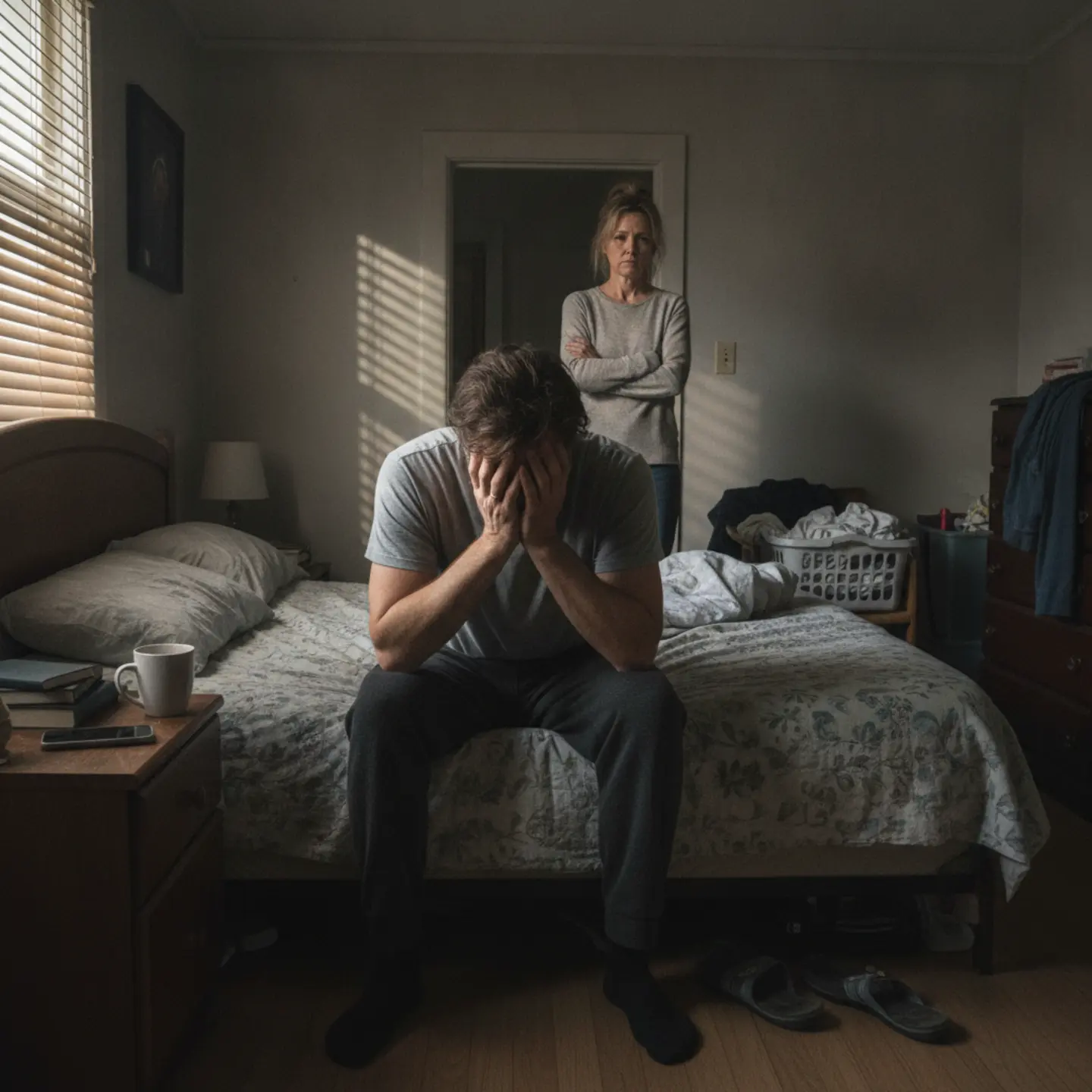
Men in recovery, shaped by traditional patterns of emotional suppression, often don’t discuss internal struggles until they’ve already escalated. They’re more likely to go quiet than to reach out. A spouse who isn’t connected to her own support network may also question herself — afraid that speaking up will come across as nagging or controlling, even when her instincts are exactly right.
If you’ve been telling yourself “he’s just stressed” for three weeks in a row, that’s worth paying attention to. Stress is real. But stress in early recovery isn’t the same as stress in a stable life — the coping tools are newer, the brain is more reactive, and the stakes are higher. You’re not being paranoid. You’re being observant.
The goal isn’t to monitor him like a parole officer. It’s to know him well enough to notice when something’s shifted — and to say something before it becomes a crisis.
The Meeting Attendance Drop: A Measurable Relapse Predictor
Of all the warning signs, a sudden decrease in 12-step meeting attendance is one of the most concrete and measurable. Individuals who relapse in months two and three often stopped attending meetings in month one — because they felt fine. That’s not a coincidence. Consistent engagement in 12-step fellowships significantly reduces relapse rates by providing ongoing peer support, mentorship, and practical tools for navigating triggers. When that infrastructure weakens, vulnerability increases.
From your perspective, this looks like fewer meetings on the shared calendar, less frequent mentions of his sponsor, or a string of excuses for why he couldn’t make it this week. Each one, in isolation, sounds reasonable. As a pattern, it signals that the external support structure holding his recovery together is quietly coming apart. For more on how structured accountability reinforces meeting attendance, see how sober living and relapse prevention accountability work together in practice.
Co-occurring Mental Health Symptoms That Spouses Misattribute to ‘Adjustment Stress’
Anxiety spikes, mood cycling, and intrusive thoughts are frequently dismissed as normal post-rehab adjustment — when they are actually significant relapse indicators. Untreated mental health symptoms are among the leading contributors to relapse, and the two conditions feed each other in a feedback loop that’s hard to break once it gains momentum.
A 2020 study found that early affective instability — particularly elevated irritability and anxiety — preceded full relapse episodes by an average of 18 days in individuals with co-occurring mental health disorders. That’s nearly three weeks of observable warning signs before a physical relapse occurs. Sleep disruption compounds everything: research shows that 60% of alcohol patients with insomnia before treatment relapsed within five months, compared to 30% of those who slept well. Poor sleep impairs emotional regulation, weakens impulse control, and increases vulnerability to stress-driven cravings — all at once.
Chronic stress creates a feedback loop where weakened impulse control increases vulnerability to substance use, which intensifies cravings, which reduces the capacity to cope with the next stressor. When you notice your husband cycling through anxiety, irritability, and poor sleep — and he’s attributing it all to “getting back to normal life” — that pattern deserves a closer look, not a pass.
The Timeline Matters: What Different Phases of Early Recovery Look Like
Relapse risk doesn’t stay constant across the first six months — it shifts in character and intensity. Knowing what to watch for at each phase helps you stay calibrated rather than either over-alarmed or under-prepared.
The ‘Pink Cloud’ Breaks Around Week 3-6 — Prepare for the Hard Stretch
The initial feel-good phase after rehab typically breaks around weeks 3-6. Energy levels drop, sleep regresses, old triggers re-emerge, and this is often described as the “hardest stretch.” This is when relapse risk actually peaks, not when he first comes home.
First 30 Days — The Pink Cloud Phase
Many men feel surprisingly good in the first two to four weeks post-discharge. The absence of acute withdrawal and the novelty of clarity create a “pink cloud” effect that can mask underlying vulnerabilities. Watch for the very start of emotional relapse: subtle irritability, restlessness, early isolation, or premature statements that he’s “got this handled.”
60–90 Days — The Hard Stretch
The pink cloud breaks. Energy drops, sleep often regresses, and old triggers re-emerge as real-world demands pile back on. This is the period of highest acute relapse risk. Watch for pronounced sleep disruption, mood cycling, a significant drop in meeting attendance, and any romanticizing of past use.
3–6 Months — Complacency and Ambush Situations
Relapse risk shifts from acute craving to complacency. The routines built in earlier stages are tested against sustained work, family, and financial demands. Watch for sustained patterns of avoiding support, emotional bottling, workaholism replacing substance use, and lingering cognitive or mood symptoms (Post-Acute Withdrawal Syndrome) that heighten vulnerability.
Not Sure If What You’re Seeing Is a Warning Sign?
You don’t have to figure this out alone. Drew’s team has worked with families across San Antonio and New Braunfels who were asking the exact same questions you’re asking right now. A conversation costs nothing — and it might change everything.
What Spouses Should Actually Do When They Notice Warning Signs
Recognizing warning signs is only half the equation. The other half is knowing how to respond without triggering shame, defensiveness, or a shutdown. The good news: the approach that works is also the most compassionate one.
Lead with specific observations, not character judgments. “I’ve noticed you’ve been skipping your meetings this week” lands very differently than “You’re not taking your recovery seriously.” The first is a fact he can respond to. The second is an accusation he’ll defend against. Point to concrete behavioral changes — sleep patterns, meeting attendance, sponsor contact, changes in mood — and frame them as things you’ve noticed, not things you’re accusing him of.
Express concern and love in the same breath, and encourage re-engagement with his recovery supports: his therapist, his sponsor, his home group. Early, calm intervention can prevent a lapse from escalating into a full relapse. The difference between the two is often whether someone said something — calmly, specifically, and soon enough.
One of the most important distinctions you can make is between supporting recovery and enabling it. Supporting recovery means encouraging personal responsibility, honesty, and engagement with his support system. Enabling means protecting him from the natural consequences of his choices — making excuses for missed obligations, covering financial gaps created by his behavior, or repeatedly absorbing responsibilities that belong to him. Both feel like love in the moment. Only one of them actually helps. The family resources at Drew’s Sober Living can help you work through this distinction in the context of your specific situation.
When You Notice Warning Signs: A Practical Response Checklist
- Name specific behavioral changes — not character flaws (“You’ve been skipping meetings” not “You don’t care about recovery”)
- Express concern and love in the same conversation
- Encourage re-engagement with his therapist, sponsor, or home group
- Distinguish between support (encouraging responsibility) and enabling (absorbing consequences)
- Set firm boundaries — and hold them, even when it’s uncomfortable
- Reach out to your own support network before the situation escalates
Why Your Own Recovery Support Matters — And What It Looks Like
Over 75% of caregivers experience burnout — and 60% report chronic stress, 50% anxiety, and 40% depression. If you’re the spouse of a man in early recovery, those numbers aren’t abstract. They describe what happens when you pour everything into someone else’s stability without building your own.
Here’s what the research also shows: individuals in couples-based addiction treatment have better outcomes than those in individual treatment alone. When you’re educated, supported, and emotionally regulated, you become a vital part of the recovery environment — not just a bystander hoping for the best. Al-Anon meetings through the San Antonio Al-Anon Information Service (SAAIS) serve Bexar and Comal counties in multiple formats, including in-person, hybrid, and online. SMART Recovery Family & Friends uses the CRAFT model to give you practical tools for encouraging recovery without enabling. Family therapy offered through many local IOPs and treatment centers teaches communication strategies that reduce relapse risk for both of you.
Your Own Support Isn’t Selfish — It’s Essential
Over 75% of caregivers experience burnout. Engaging in Al-Anon, SMART Recovery Family & Friends, or family therapy isn’t just good for you — research shows it directly improves your husband’s recovery outcomes by fostering a healthier, more supportive home environment.
Getting support for yourself isn’t a distraction from helping him. It’s what makes your help sustainable — and effective. You can also explore the family decision guide for choosing sober living in Texas to better understand what structured accountability looks like from a family’s perspective.
Why Choose Drew’s Sober Living as the Right Choice for San Antonio and New Braunfels Families
Drew’s Sober Living has four operating houses, 38 beds across San Antonio and New Braunfels — Chittim House, Evergreen House, and Chapel Bend — with 27 beds total and the same daily accountability standard across every location. Every resident is breathalyzed daily and drug screened every two weeks. That’s not a policy on paper — it’s the operational reality that directly addresses the warning signs you’ve been reading about in this post. When isolation, complacency, and loss of routine are the primary drivers of relapse, daily structure and daily accountability are the counter.
Drew’s holds a perfect 5.0-star Google rating across 91 verified reviews — earned from families and treatment centers who needed to know the program would hold when it mattered most. Founded in 2023 by Drew, who built every house policy from his own recovery experience, the program emphasizes action alongside structure: a strongly encouraged 30 hour work week, mandatory daily 12-step meeting attendance, and financial literacy training. These aren’t arbitrary rules. They’re the daily consistency that prevents the isolation, complacency, and loss of routine that precede relapse. And 83% of past residents moved out sober — which is the number that matters most to families in your position.
Schedule a call with Drew’s Sober Living today — if you’ve recognized warning signs in your husband or partner and want to explore a structured, accountable environment that keeps him engaged during the highest-risk window, we can discuss whether our program is the right fit for your family.
Frequently Asked Questions
My husband is home from rehab and seems so much better, but I’m terrified he’ll relapse. How long until he’s really “safe”?
Relapse risk is highest in the first year after treatment, particularly within the first 30 to 90 days. While the immediate post-rehab feelings of well-being — often called the “pink cloud” — are common, true stability takes time. Sustained sobriety typically begins to solidify after several years of consistent effort and support, with risk falling significantly after around five years of continuous engagement. Spouses should understand that recovery is a long-term journey, not a milestone to reach, and consistent engagement in aftercare is crucial throughout this entire period — not just the first month.
He’s just more irritable and quiet lately, but he says it’s just stress from getting back to work. Is this a normal adjustment, or a warning sign?
While some adjustment stress is normal after returning home from treatment, increased irritability, social withdrawal, and significant changes in mood or communication are classic early warning signs of emotional relapse. These shifts often precede conscious thoughts of using substances and are frequently rationalized as ordinary stressors — which is exactly what makes them dangerous. It’s important not to dismiss a sustained pattern of these changes as mere “adjustment stress.” They can signal a weakening in coping mechanisms and a meaningful increase in relapse vulnerability, particularly in the first 60 to 90 days post-discharge.
What should I actually do if I see warning signs? I don’t want to nag or make him feel ashamed.
The key is to respond with compassion and specific observations rather than accusations. Point to concrete behavioral changes — “I’ve noticed you’ve been skipping your meetings” or “You’ve been having trouble sleeping for a week” — rather than making generalizations about his character or commitment. Express your concern and love clearly, and encourage him to re-engage with his recovery supports: his therapist, his sponsor, his home group. Early, calm intervention can prevent a lapse from escalating into a full relapse, and the tone you bring to that conversation matters as much as the content.
My husband stopped going to 12-step meetings because he says he feels fine now. Is this okay, or should I be worried?
A sudden drop in 12-step meeting attendance is a significant relapse predictor, even when he genuinely feels fine. The “pink cloud” often breaks around weeks three to six post-discharge, and many individuals relapse in months two and three precisely because they stopped attending meetings in month one. Meetings provide a critical continuing-care infrastructure that helps maintain engagement when motivation naturally wanes — and motivation always wanes at some point. Encourage consistent participation as a non-negotiable, not an optional add-on. It’s one of the strongest protective factors for long-term sobriety.
What makes Drew’s Sober Living different from other recovery housing options in San Antonio and New Braunfels?
Drew’s Sober Living combines daily accountability — breathalyzer testing and drug testing every two weeks — with a focus on action and community, not just rules. With a perfect 5.0-star Google rating across 91 verified reviews and 83% of past residents moving out sober, Drew’s has proven its model works during the highest-risk window after rehab. The program emphasizes employment, 12-step engagement, and financial literacy — the daily consistency that prevents the isolation, complacency, and loss of routine that precede relapse. Reach out to Drew’s Sober Living to discuss whether our program is the right fit for your family’s recovery journey.
Most families don’t call Drew’s because everything is fine. They call because something shifted — a few skipped meetings, a week of bad sleep, a husband who’s quieter than he used to be — and they can’t tell if they’re overreacting or if their instincts are right.
They’re usually right. And the fact that they noticed — that they paid attention closely enough to feel the shift before anything visible happened — is exactly the kind of early awareness that changes outcomes. The warning signs are real. The window to act is real. And you don’t have to figure out what to do with what you’re seeing on your own.
That’s what Drew’s is here for.
Ready to Talk About Relapse Prevention and Structured Recovery in San Antonio?
If you’ve recognized warning signs in your husband or partner — or you’re looking for a structured environment that closes the gap between rehab and independent life — Drew’s Sober Living is ready to have that conversation. No pressure, no sales pitch. Just a straightforward discussion about whether our program is the right fit for your family.
Drew’s Sober Living · Men’s Recovery Residences in San Antonio & New Braunfels, TX
Drew’s Sober Living is a structured sober living residence and does not provide clinical treatment, detox, or medical services. This article is for informational purposes only and does not constitute medical advice. Program availability, pricing, and admission requirements are subject to change, and recovery outcomes vary by individual. Please contact us directly for current information.