Key Takeaways
- Relapse rates peak in the first 90 days after treatment — up to 60–80% within the first year — making a structured daily routine your single most important defense in early recovery.
- Sleep, exercise, work, and daily fellowship are the four evidence-based pillars of an effective recovery routine; men who attend 3+ meetings per week are more than twice as likely to be abstinent at the three-year mark.
- Cravings and anxiety waves typically peak and subside within 15–20 minutes — having a written plan before they hit (call your sponsor, change your environment, move your body) is what gets you through them.
- Men who spend 6–12 months in a structured sober living residence show significantly lower relapse rates at the 18-month follow-up compared to those who return home directly from treatment.
- Trust Drew’s Sober Living for daily accountability, peer brotherhood, and a proven structure that bridges treatment and independent life — visit Drew’s Sober Living to learn how our San Antonio and New Braunfels homes can support your recovery.
How Do You Build a Daily Routine After Rehab That Actually Reduces Anxiety and Cravings?
A structured daily routine is one of the most powerful tools in early recovery — not because rules change people, but because consistent action does. Research shows that men who establish predictable sleep, exercise, work, and meeting schedules in their first 90 days after treatment have significantly lower relapse rates and report measurable reductions in anxiety within 2–4 weeks. The key is starting small, staying consistent, and building accountability into every day.
Here’s exactly how to build that routine, why each piece matters, and what to do when anxiety or cravings try to derail you.
Drews Sober Living
Every Resident Drug-Tested Every Single Day
Core Service Programs:
- Structured Sober Living Homes for men transitioning from treatment to independent, sober living
- Daily Accountability & Drug Testing for residents and families who need consistent, verifiable structure
- Life-Skills & Employment Readiness for men rebuilding work history, finances, and a sober support network
Why Choose Drews Sober Living:
- ✓ Trusted by customers with a perfect 5.0-star Google rating across 88 verified reviews
- ✓ Every resident drug-and-alcohol tested every single day — same standard, every house
- ✓ Three structured men’s recovery homes in San Antonio and New Braunfels — 27 beds total
- ✓ Live-in house managers who are men in long-term recovery themselves
- ✓ Founded in 2023 by Drew, who built every house policy from his own recovery
- ✓ 83% of residents who moved out of the program did so sober
- ✓ 30-hour weekly work requirement plus financial literacy and life-skills training
Why the First 90 Days Are the Highest-Risk Window
The numbers here aren’t meant to scare you — they’re meant to tell you the truth so you can act accordingly. Research published in the Journal of Addiction Medicine puts relapse rates at 60–80% within the first year of leaving residential treatment, with most of those relapses happening in the first three months. That’s not a character flaw. That’s biology.
Your brain is still healing from chronic substance use. The neural pathways built around using are still there, still firing, still looking for the familiar reward. A month or two in treatment is rarely enough to prepare for the real-world weight of bills, relationships, boredom, and stress. That’s not a criticism of treatment — it’s just the reality of what you’re stepping back into.
It’s Normal to Feel Overwhelmed Right Now
Early recovery brings a tsunami of emotions, physical symptoms, and decisions all at once. The anxiety, the restlessness, the fear that you’ll never feel normal again — these are universal experiences, not signs of failure. Thousands of men have felt exactly what you’re feeling right now and have built solid, sober lives on the other side.
Post-Acute Withdrawal Syndrome (PAWS) compounds all of this. It can cause waves of anxiety, irritability, and mood swings for up to 18–24 months after your last use. A predictable daily routine doesn’t cure PAWS, but it does something critical: it calms your nervous system and gives your brain the consistent, low-stress environment it needs to heal. Structure is medicine here.
The Four Pillars of a Recovery Routine: Sleep, Exercise, Work, and Fellowship
Every solid recovery routine is built on the same four pillars. These aren’t arbitrary suggestions — each one is backed by research on what actually reduces anxiety and cravings in early recovery. Miss one consistently and the others start to wobble.
Start With One Pillar, Not All Four
If the full routine feels impossible, pick one pillar — sleep, exercise, work, or meetings — and nail that first. Once that’s solid, add the next. Small wins build momentum. You don’t have to be perfect; you have to be consistent.
Sleep: The Foundation of Everything
Up to 75% of men in early recovery report sleep problems — and poor sleep isn’t just uncomfortable, it’s a craving accelerant. Research in Alcoholism: Clinical & Experimental Research shows that establishing a fixed bedtime and wake-up time can improve sleep quality within 2–4 weeks and is correlated with a 30% reduction in self-reported cravings. Same time every morning, even on weekends. No screens 30 minutes before bed. Your brain is still healing and needs real, uninterrupted rest — not the half-sleep of someone scrolling their phone at midnight.
Exercise: Rewiring Your Brain’s Reward System
Your brain spent a long time getting flooded with dopamine from substances. Now it has to learn how to produce it naturally again. A NIDA-funded study found that just 30 minutes of moderate aerobic exercise three times per week measurably reduces anxiety and improves mood in early recovery. Start small — a 20-minute walk absolutely counts. The goal isn’t fitness; it’s burning off the restless, anxious energy that early recovery brings and giving your brain a healthy dopamine hit. If you can find a gym buddy or a recovery-focused fitness group, even better — you’re adding accountability on top of the physical benefit.
Work or Structured Productivity: Purpose and Stability
Employment is one of the strongest predictors of long-term recovery. A study in the Journal of Social Work Practice in the Addictions found that gaining and maintaining work provides structure, financial stability, a sense of purpose, and daily accountability — four things early recovery desperately needs. If you’re not ready for full-time work yet, volunteer, take a class, or pursue job training. The form matters less than the function: you need a reason to get up, get dressed, and show up somewhere every day. Financial desperation is one of the biggest relapse triggers — a job removes it.
Fellowship: Daily Connection to Your People
Project MATCH — one of the largest alcoholism treatment studies ever conducted — found a direct correlation between 12-step meeting attendance and positive outcomes. Men who attend three or more meetings per week in their first year are more than twice as likely to be abstinent at the three-year mark. Daily meetings in early recovery aren’t about religion or ritual. They’re about immersing yourself in a culture of sobriety, hearing from men who are further along, and getting a daily reminder of why you’re doing this — because your brain will try to forget. A sponsor and a home group give you accountability and a safe place to talk when things get hard.
A Sample Daily Routine: What 24 Hours Looks Like in Early Recovery
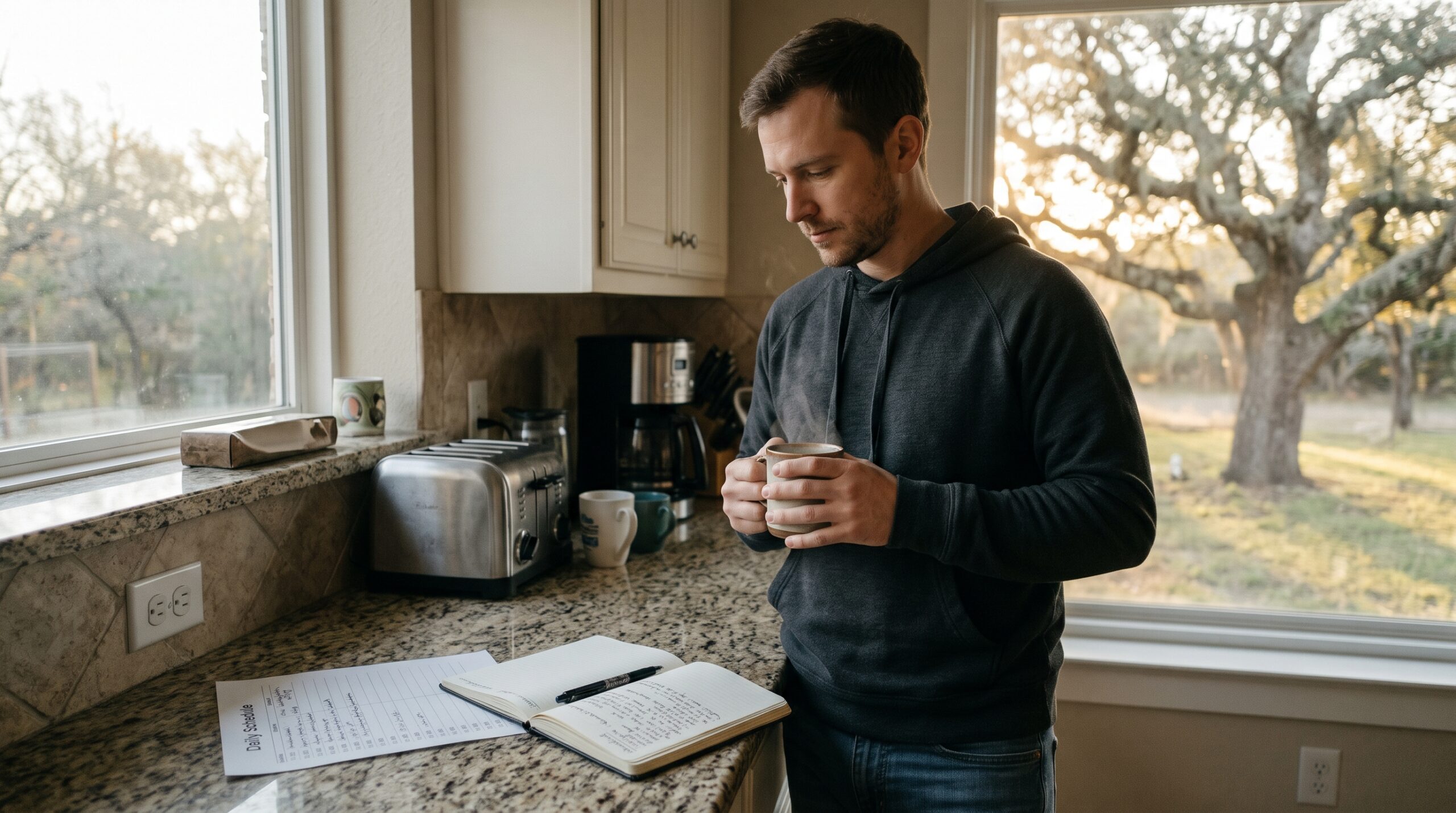
One of the most paralyzing parts of early recovery is staring at an empty day and not knowing where to start. Here’s a concrete template you can adapt. It’s not perfect — your schedule will look different — but it gives you a framework to work from rather than a blank page to stare at.
| Time | Activity |
|---|---|
| 6:30 AM | Wake up, make your bed, shower — small wins build momentum |
| 7:00 AM | Breakfast and quiet time — meditation, journaling, or just coffee and silence |
| 8:00 AM | Work, job training, volunteer work, or job search — non-negotiable |
| 12:00 PM | Lunch; check in with a friend or sponsor if anxiety is high |
| 1:00–5:00 PM | Continue work or productivity; house chores if in sober living |
| 5:30 PM | Dinner; help with house responsibilities |
| 7:00 PM | 12-step meeting or peer support group — your daily anchor |
| 8:30 PM | Free time — call a friend, read, a hobby; not alone, not in your head |
| 10:00 PM | Wind down, no screens, prepare for bed |
| 10:30 PM | Lights out |
You don’t have to nail this schedule on day one. The point isn’t perfection — it’s pattern. Every day you follow this structure, even imperfectly, you’re laying another brick in the foundation. Three weeks from now, waking up at 6:30 won’t feel like a battle. It’ll just be what you do.
The men who struggle most in early recovery aren’t the ones who had the worst addiction. They’re the ones who had the most unstructured time. Don’t give your brain that kind of room to work against you.
What to Do When Anxiety Hits — And It Will
Anxiety in early recovery isn’t a sign you’re failing. It’s a sign your nervous system is recalibrating after years of being chemically regulated. PAWS can produce waves of anxiety, irritability, and mood swings for months — that’s not weakness, it’s neuroscience. The good news: most anxiety waves peak and subside within 15–20 minutes if you don’t feed them with rumination or isolation.
The key is having a plan before anxiety hits, not trying to build one in the middle of a panic. Write it down. Put it on your phone. Know exactly what you’re going to do when the wave comes.
Your Anxiety Toolkit — Use This When Panic Hits
When Anxiety Spikes, Run This List
- Call your sponsor or another man in recovery — don’t sit alone with it
- Go to a 12-step meeting, even an online one if nothing local is available right now
- Change your environment immediately — leave the house, go to a coffee shop, go to the gym
- Move your body: walk, run, push-ups, yard work — anything physical
- Write down what you’re anxious about; the fear is usually bigger than the reality on paper
- Remind yourself: this feeling is temporary, you have tools, and you’ve gotten through hard moments before
Movement is your fastest anxiety-killer. The restless, wired energy that anxiety brings has a physical outlet — use it. A 15-minute walk will do more for your nervous system in that moment than 30 minutes of trying to think your way through it.
Cravings: Why They Happen and How Your Routine Prevents Them
A craving is not a moral failure. It’s your brain remembering a reward and reaching for it out of habit. The neural pathways built around substance use don’t disappear when you get sober — they get quieter over time, but in early recovery they’re still loud. Sleep deprivation, stress, isolation, and boredom are the four biggest amplifiers. Your routine eliminates all four.
Isolation Is a Relapse Accelerant
The biggest threat to your routine isn’t the craving itself — it’s sitting alone with it. If you’re spending hours by yourself, especially in your room or at home, your relapse risk skyrockets. Your routine must include daily connection to other people, whether that’s work, meetings, or a structured sober living home.
A man who is working, exercising, sleeping well, and connected to his people has far fewer cravings than a man sitting at home watching TV. That’s not an opinion — it’s what the research on clinically proven craving-reduction methods consistently shows. When a craving does hit, it will pass. Most peak within 15–20 minutes if you don’t act on it. Your job is to get through those 15 minutes.
The Craving Prevention Checklist
- Sleep 7–9 hours — sleep deprivation is a direct craving trigger
- Exercise daily or at least three times per week — regulates dopamine and burns restless energy
- Eat regular meals — low blood sugar amplifies cravings and anxiety
- Attend your meeting every single day — immersion in recovery culture is protective
- Stay connected to your people — isolation is a craving accelerant
- Work or stay productive — boredom and purposelessness are major triggers
- Avoid old people, places, and things — your brain is still vulnerable to environmental cues
Structured Sober Living vs. Going Home: Why Your Environment Is Part of the Routine
You can build the best daily routine in the world on paper. But if you’re executing it in the same environment where you used — surrounded by the same people, the same triggers, the same dynamics — that routine is fighting uphill every single day. Your brain and your old environment are not yet compatible. That’s not a permanent truth, but it is the truth right now.
Research published in the Journal of Psychoactive Drugs found that men who spent 6–12 months in a structured sober living residence had significantly lower relapse rates at the 18-month follow-up compared to those who returned home directly from treatment. A structured environment doesn’t do the work for you — but it removes the obstacles that derail men before the work can take hold. For more on what this transition looks like in practice, the guide on transitional housing after 30-day rehab breaks it down in detail.
Sober living is not a punishment or a step backward. It’s a strategic bridge — from treatment to independent life — that gives your routine the best possible environment to take root. Daily drug and alcohol testing, peer accountability, house rules, a built-in schedule: these aren’t restrictions. They’re the scaffolding your brain needs while it heals.
Wondering If Structured Sober Living Is the Right Next Step?
If you’re weighing your options after treatment, you don’t have to figure it out alone. Drew’s team responds within 24 hours and can walk you through what the program looks like, what it costs, and whether it’s a fit — no pressure, just an honest conversation.
Why Choose Drew’s Sober Living for Your Recovery Foundation
Drew’s Sober Living operates three structured men’s recovery homes — Chittim House and Evergreen House in San Antonio, and Chapel Bend in New Braunfels — with 27 total beds and a perfect 5.0-star Google rating across 88 verified reviews. That rating isn’t a marketing number. It’s what happens when a program actually works and the men who’ve been through it are willing to say so publicly.
Every resident at Drew’s follows the exact routine framework outlined in this article — not as a suggestion, but as a daily commitment. Daily breathalyzer testing from day one. Bi-weekly drug screening. A 30-hour weekly work requirement. Daily 12-step meeting attendance. Financial literacy training. We don’t just talk about structure; we live it, house by house, resident by resident, day by day.
Drew founded this program from his own recovery. The house policies weren’t written by a committee or a clinical board — they were built by a man who knows what early sobriety actually feels like and what it takes to get through it. Our full program details reflect that: this is a brotherhood, not a facility. The men around you aren’t strangers — they’re people invested in your success because they’ve been exactly where you are.
Schedule a call with Drew — and let’s talk about building your foundation in San Antonio or New Braunfels.
Frequently Asked Questions
How do I stop the constant anxiety now that I’m sober?
Anxiety is extremely common in early recovery as your brain and nervous system heal from chronic substance use. Research consistently shows that building a predictable daily routine is one of the most powerful non-medical tools available to manage it. Simple, consistent actions — waking up at the same time, making your bed, exercising, and eating regular meals — signal safety to your nervous system and can make anxiety feel significantly more manageable within 2–4 weeks. If anxiety is severe or persistent, talk to a medical professional, but don’t underestimate what structure alone can do.
What do I do when a craving hits? It feels like it will last forever.
Cravings feel overwhelming but are temporary — most peak and subside within 15–20 minutes if you don’t act on them. The best defense is a plan you’ve made before the craving arrives: immediately call your sponsor or another man in recovery, go to a 12-step meeting, or change your environment by going for a walk or to the gym. Don’t sit alone with it — connection and movement are your fastest tools, and they work faster than you’d expect in the middle of a bad moment.
I feel so bored and restless. Is this normal?
Yes — completely normal, and often a sign of a brain that’s healing. Your reward system spent a long time getting flooded with intense stimulation; normal life genuinely can feel flat and boring by comparison for a while. That’s not permanent, and it’s not a sign that sober life isn’t worth it. The key is filling your routine with positive, structured activities — a job, volunteer work, exercise, and fellowship — to start building new, healthy pathways for reward and purpose. The boredom fades as those pathways strengthen.
Why do I have to go to a meeting every single day?
Daily meeting attendance in early recovery serves several evidence-based purposes: it provides structure, immerses you in a culture of sobriety, offers a daily dose of hope, and keeps you connected to a support network when you need it most. Most critically, it’s a daily reminder of the consequences of the first drink or drug — which matters because your brain will actively try to minimize those consequences over time and convince you that using again is safe. Project MATCH, one of the largest alcoholism treatment studies ever conducted, found a direct correlation between meeting attendance and long-term abstinence. Daily attendance in early recovery isn’t overkill; it’s the dose that works.
What makes Drew’s Sober Living different from other recovery housing options?
Drew’s Sober Living is built on the exact framework outlined in this article: daily testing, structured accountability, peer brotherhood, and a commitment to long-term recovery — not just 30-day completion. With a perfect 5.0-star Google rating across 88 verified reviews and 83% of past residents moving out sober, the model has proven itself in real outcomes with real men. Drew founded the program from his own recovery, so the house policies weren’t designed from a clinical textbook — they were built by someone who understands the daily grind of early sobriety from the inside. If you’re ready to build a real foundation, schedule a call with Drew’s team to discuss how our homes in San Antonio and New Braunfels can support your recovery.
The men who build the most solid recoveries aren’t the ones who had the easiest path. They’re the ones who showed up every day — to the job, to the meeting, to the chores, to the hard conversations — even when it felt pointless. They made their bed when they didn’t want to. They went to the meeting when they were sure it wouldn’t help. They called their sponsor when every instinct said to sit alone with it instead.
That’s what a daily routine actually is: a thousand small decisions to keep showing up. And every one of those decisions builds something — a foundation that gets stronger the longer you stand on it. The anxiety gets quieter. The cravings get shorter. The life on the other side of all those small decisions starts to feel real.
You don’t have to build it alone. That’s what the brotherhood is for.
Ready to Build Your Daily Recovery Routine in a Structured Environment?
If you’re serious about putting the framework in this article into daily practice — with accountability, brotherhood, and a team that’s been where you are — Drew’s Sober Living in San Antonio and New Braunfels is ready to talk. Reach out today and get a response within 24 hours.
Drew’s Sober Living · Men’s Recovery Residences in San Antonio & New Braunfels, TX
Drew’s Sober Living is a structured sober living residence and does not provide clinical treatment, detox, or medical services. This article is for informational purposes only and does not constitute medical advice. Program availability, pricing, and admission requirements are subject to change, and recovery outcomes vary by individual. Please contact us directly for current information.