Key Takeaways
- If your parole conditions mandate a Residential Reentry Center (RRC), that is your legally required path — but if you have discretion in choosing your housing, a structured sober living home is often the stronger option for long-term recovery.
- Halfway houses (RRCs) are state-contracted, TDCJ-supervised facilities where placement is assigned — not applied for — and violations can result in reincarceration; sober living homes are voluntary, peer-driven residences where violations result in dismissal, not prison.
- Cost differs significantly: RRC residents pay 25–30% of income (state-subsidized), while sober living requires full rent ($500–$2,500/month in Texas) plus move-in fees — but financial assistance through Oxford House loans and Bexar County Reentry Center referrals can bridge the gap.
- Texas recidivism data shows a 20.3% reincarceration rate for parolees within three years; stable housing in the first 90 days post-release is one of the strongest predictors of staying out — making the housing choice you make right now one of the most consequential decisions of your reentry.
- Trust Drew’s Sober Living for structured accountability, daily drug testing, and a proven brotherhood that bridges treatment and independent life — visit Drew’s Sober Living to learn more and take the next step.
Halfway House vs Sober Living in San Antonio: Which Is Better for Felons and Parolees?
The choice depends on whether you’re mandated to a halfway house or have discretion in your housing. If your parole officer requires a Residential Reentry Center (RRC), that’s your path. If you have the freedom to choose an approved residence and you’re serious about recovery, a structured sober living home like Drew’s Sober Living often delivers better long-term outcomes because it balances accountability with the autonomy you need to rebuild as an adult. Both serve a purpose — but sober living is designed specifically for men ready to build a better life, not just serve time in the community.
Understanding the real differences — cost, daily structure, autonomy, and how each affects your chances of staying sober — is critical to making the right call for your reentry.
Drews Sober Living
Every Resident Drug-Tested Every Single Day
Core Service Programs:
- Structured Sober Living Homes for men transitioning from treatment to independent, sober living
- Daily Accountability & Drug Testing for residents and families who need consistent, verifiable structure
- Life-Skills & Employment Readiness for men rebuilding work history, finances, and a sober support network
Why Choose Drews Sober Living:
- ✓ Trusted by customers with a perfect 5.0-star Google rating across 88 verified reviews
- ✓ Every resident drug-and-alcohol tested every single day — same standard, every house
- ✓ Three structured men’s recovery homes in San Antonio and New Braunfels — 27 beds total
- ✓ Live-in house managers who are men in long-term recovery themselves
- ✓ Founded in 2023 by Drew, who built every house policy from his own recovery
- ✓ 83% of residents who moved out of the program did so sober
- ✓ 30-hour weekly work requirement plus financial literacy and life-skills training
What Halfway Houses (RRCs) Actually Are in Texas
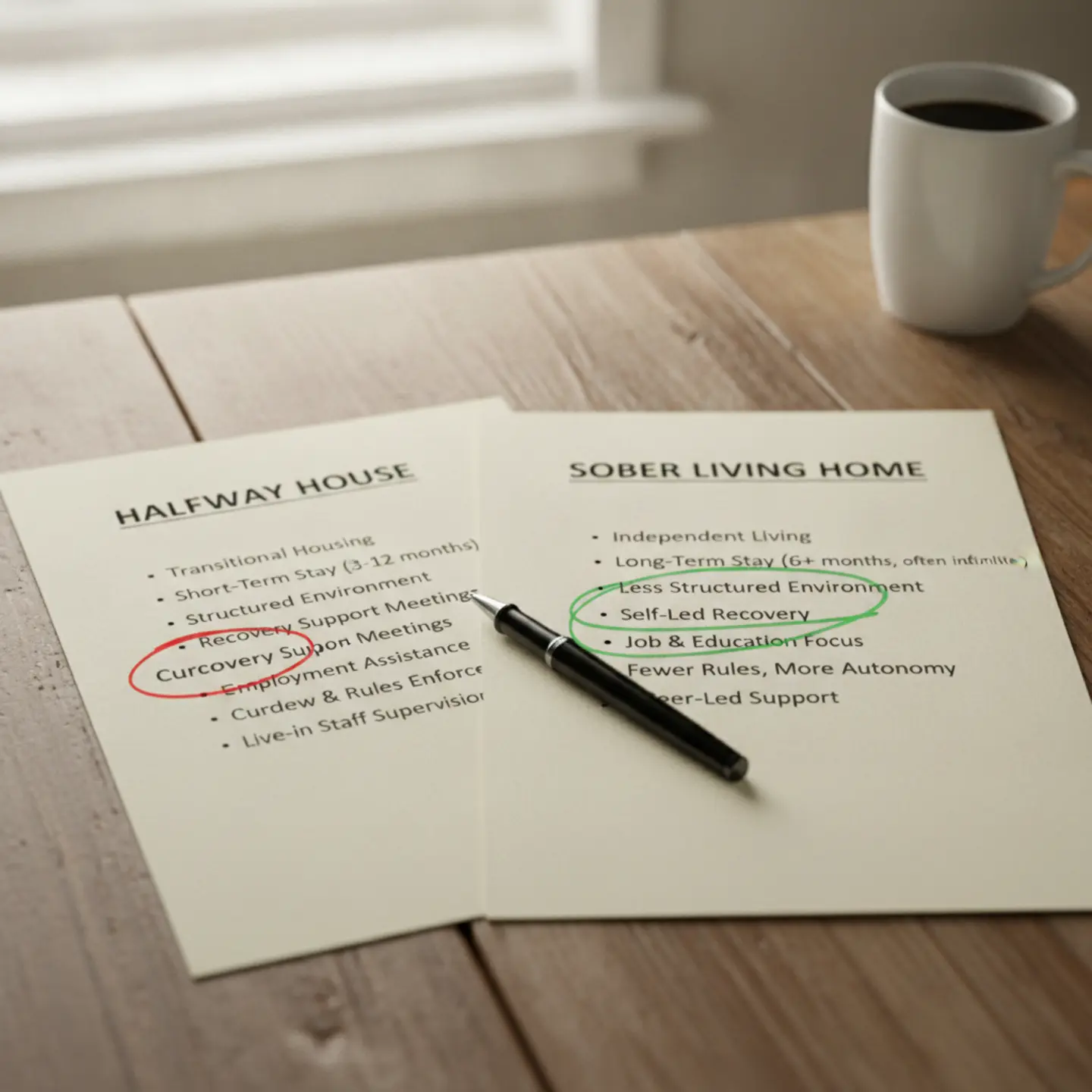
A Residential Reentry Center is not a sober living home, and it’s not a treatment center. It is a state-contracted correctional facility operated under TDCJ oversight, designed to provide supervised community reintegration for parolees who require a higher level of external structure. You don’t apply to an RRC — the Texas Board of Pardons and Paroles assigns you to one based on your risk assessment, offense history, and whether you have an approved home plan.
Daily life inside an RRC is highly regimented. Mandatory programming runs throughout the day — cognitive behavioral therapy, substance abuse education, employment counseling, and life skills classes. Curfews are strict, often 10 PM or earlier. Passes for outside activities require prior approval, and overnight stays are rare. Employment is mandatory once secured, and residents pay 25–30% of their income as a board fee, with the state subsidizing the remainder. The primary motivator for compliance is the threat of reincarceration: violate the rules, and your parole officer initiates revocation proceedings.
It’s Normal to Feel Scared About This Choice
Whether you’re facing a mandatory halfway house or choosing sober living, uncertainty is real. You’re not alone in wondering if you can actually stay sober, find a job, and rebuild your life. The fact that you’re researching your options means you’re already taking it seriously.
For men who are mandated to an RRC, the structure and supervision serve a real purpose — especially immediately post-release when external accountability is the only kind available. But for men who have discretion in choosing their housing, an RRC’s institutional environment is not the only path forward, and it may not be the most effective one for building durable, self-directed sobriety.
What Sober Living Homes Are (and How They Differ from Halfway Houses)
Sober living homes are not correctional facilities, not treatment centers, and not mandated by parole. They are voluntary, approved residences where men in recovery live together under a structured set of rules designed to support sobriety and self-sufficiency. The model is peer-driven: accountability comes from the brotherhood around you, not from a correctional officer with the authority to send you back to prison.
Structure is real and non-negotiable in a well-run sober living home — daily breathalyzers, bi-weekly drug screening, mandatory 12-step meeting attendance, employment requirements, and house chores. But residents keep their phones, choose their own jobs, and manage their personal schedules around program requirements. They live like adults, not inmates. Stays typically run 3–12 months, flexible based on when a resident is genuinely stable and ready to live independently — not on a predetermined release date set by the state.
Here’s the real difference: in a halfway house, you stay sober because you’re afraid of going back to prison. In sober living, you stay sober because the men around you are doing the same work, and you don’t want to let them down — or yourself. One of those motivations lasts a lot longer than the other.
Zero-tolerance means zero-tolerance. Fail a drug test at Drew’s and you’re dismissed from the program — not reincarcerated, but done. That consequence is real enough to matter, and it motivates genuine sobriety rather than just compliance.
Research consistently shows that voluntary, peer-driven recovery environments foster more durable, self-directed sobriety than institutional settings. The internal motivation built in sober living — because you chose to be there, because the men around you chose it too — is the kind that survives long after you move out. You can read more about the full structure of Drew’s program to understand exactly what that accountability looks like day to day.
Cost Comparison: Halfway Houses vs Sober Living in San Antonio
Beware of Housing Discrimination Based on Your Record
Many private landlords and sober living homes will reject you outright because of a felony conviction, even though fair-chance housing advocates are pushing back. This is why working with a reentry-focused program like Drew’s Sober Living — or getting a referral through the Bexar County Reentry Center — is critical. They know which doors will actually open for you.
| Cost Factor | Halfway House (RRC) | Sober Living (e.g., Drew’s) |
|---|---|---|
| Monthly Housing Cost | 25–30% of income; state-subsidized | $500–$2,500/month full rent |
| Move-In Fee | None (state-placed) | $100 + two weeks rent upfront |
| Supervision Fees | ~$60/month (parole) | ~$60/month (parole) |
| Drug Testing | Included in program | Included at Drew’s |
| Financial Assistance | State subsidy built in | Oxford House loans, Bexar County Reentry referrals, non-profit deposit assistance |
| Hidden Costs | Transportation, work clothing, fines, restitution | Transportation, work clothing, fines, restitution |
| Long-Term Cost of Failure | Reincarceration costs Texas $27,000–$30,000/year per person | |
The RRC looks cheaper on paper because the state absorbs most of the cost. But that subsidy comes with the institutional structure attached. For men who can access financial assistance — Oxford House offers interest-free loans for move-in costs, and the Bexar County Reentry Center (222 S Comal St) connects individuals to non-profits that assist with deposits and first rent — sober living becomes financially accessible. And the long-term math is clear: a year of stable sober living costs a fraction of what reincarceration costs Texas taxpayers, and it builds something that lasts. For a detailed breakdown of what recovery housing actually costs in South Texas, the San Antonio recovery housing cost guide is worth reading before you make any decisions.
Daily Life: What You Actually Experience in Each Setting
The day-to-day experience in an RRC feels institutional because it is. Your schedule is set for you. Mandated classes run back-to-back. Curfews are enforced by staff, not by your own sense of responsibility. Employment is required, but the environment around it is managed externally. The accountability is real — but it’s the accountability of surveillance, not brotherhood.
At Drew’s Sober Living, a typical day looks different. You wake up by 10 AM Monday through Friday. You blow into the breathalyzer. You go to work — a job you found, at a place you chose. You hit a 12-step meeting. You do your assigned house chores. You show up to financial literacy training. And when you’re slipping, another man in the house notices before you do and says something. That’s not surveillance. That’s brotherhood, and it’s functional.
RRC stays are typically 3–6 months, determined by your parole conditions. Sober living stays at Drew’s run 3–12 months, and there’s no arbitrary graduation date — you leave when you have stable employment, managed finances, a sober support network, and demonstrated readiness. That flexibility is the difference between checking a box and building a foundation.
How Parole Officers Approve Sober Living (and When They Won’t)
If you are not mandated to an RRC, you can propose an approved residence — including a sober living home — to your parole officer. The PO will review the home’s structure, drug-free environment, testing protocols, curfew policies, and whether the operator is willing to communicate directly with the parole division. What they’re looking for is evidence that the environment will hold you accountable and support your parole conditions, not just give you a place to sleep.
NARR/TROHN certification — the national and Texas state standard for recovery residences — significantly increases approval odds because it signals recognized quality to a PO who may not know the home personally. Your PO will also verify that no prohibited persons (co-defendants, victims) live in the home and that the environment doesn’t conflict with any special conditions of your parole. Approval typically takes days to weeks, depending on how complete your documentation is when you present it.
The Parole Approval Process Moves Faster with Preparation
If you’re considering sober living, start building your home plan now — before release if possible. Have the sober living home’s address, house rules, testing protocols, and operator contact info ready for your parole officer. The more complete your documentation, the faster approval happens — days instead of weeks.
Drew’s Sober Living coordinates directly with parole officers — with the resident’s consent — providing documentation of compliance, drug test results, employment verification, and program participation. That kind of direct communication removes friction from the approval process and keeps your PO informed without requiring you to manage every conversation yourself. Learn more about the admissions process at Drew’s to understand exactly what documentation is available for your home plan.
Not Sure Which Path Is Right for Your Reentry?
You don’t have to figure this out alone. Drew’s team understands the parole approval process, the reentry landscape in San Antonio, and what it actually takes to build a life after incarceration. Reach out — no pressure, just a real conversation about your situation.
Top Reentry Housing Options in San Antonio: Compared and Reviewed
Bexar County has a range of reentry housing options — from state-contracted RRCs to non-profit transitional housing to structured sober living homes. Here’s an honest look at what’s actually available and who each option serves best.
Drew’s Sober Living (Chittim House, Evergreen House, Chapel Bend)
Drew’s operates three structured men’s recovery residences: Chittim House in North San Antonio (10 beds), Evergreen House in Central San Antonio (8 beds), and Chapel Bend in New Braunfels (9 beds) — 27 beds total across three houses running the same program. Eligibility is males 18+, committed to sobriety, court-ordered or voluntary. Drew’s evaluates individuals on a case-by-case basis and meets most Texas court-ordered requirements for felons.
Move-in requires a $100 fee covering the first two weeks, then ongoing rent in the Texas sober living range. The program includes daily breathalyzer testing, bi-weekly drug screening, a 30-hour weekly work requirement after probation, mandatory 12-step meeting attendance, financial literacy training, house chores, and a 10 PM weeknight curfew during the 30-day probationary period. Zero-tolerance covers drugs, alcohol, Kratom, K2, and CBD — refusing or failing a test carries the same outcome as a positive result. Residents keep their phones, choose their own employment, and manage their schedules around program requirements. Google reviews: a perfect 5.0 stars across 88 verified reviews, with consistent praise for structure, brotherhood, and genuine support.
Haven for Hope (San Antonio)
Located at 1 Haven for Hope Way, San Antonio, TX 78207, Haven for Hope operates over 1,000 beds across emergency shelter, transitional housing, and permanent supportive housing. It serves individuals experiencing homelessness — including justice-involved individuals and those with substance use histories — with comprehensive on-campus services: case management, job training, mental health services, substance abuse counseling, and medical care. Cost varies by program; some services are free or sliding-scale. Google rating: 4.3 stars across 1,200+ reviews. Not specifically designed for parolees, but welcomes them. Best suited for individuals who need comprehensive wraparound services alongside housing, particularly those coming out of homelessness rather than directly from treatment.
Bexar County Reentry Center (Resource Hub)
Located at 222 S Comal St, San Antonio, TX 78207, the Bexar County Reentry Center is not a residential facility — it’s a free resource and referral hub for justice-involved individuals. Staff provide employment assistance, case management, and connections to housing, substance abuse recovery services, and legal aid. If you’re unsure where to start or need help navigating the local reentry ecosystem, this is the right first call. They know which doors are actually open to people with felony records.
Dave Coy Salvation Army Men’s Shelter (San Antonio)
Located at 226 Nolan St, San Antonio, TX 78202, the Dave Coy shelter provides emergency housing for homeless men, including those with criminal histories, at free or minimal cost. Google rating: 4.1 stars across 300+ reviews. This is an emergency option — useful as a bridge when nothing else is immediately available, but not designed for the structured, recovery-focused reentry that reduces recidivism. If you land here, use the Bexar County Reentry Center to move toward something more structured as quickly as possible.
| Provider | Type | Cost | Felony-Friendly | Recovery Focus | Parole Coordination |
|---|---|---|---|---|---|
| Drew’s Sober Living | Structured sober living | $100 move-in + rent | Yes — case-by-case | High (daily testing, 12-step) | Yes — direct with PO |
| State RRC (TDCJ) | Correctional reentry | 25–30% of income | Mandated placement | Moderate (mandated programs) | Built-in (TDCJ oversight) |
| Haven for Hope | Non-profit transitional | Free/sliding-scale | Yes (case-by-case) | Moderate (wraparound services) | Limited |
| Bexar County Reentry Center | Resource hub (non-residential) | Free | Yes | Referral-based | Referral support |
| Salvation Army Men’s Shelter | Emergency shelter | Free/minimal | Generally yes | Low | None |
Why Drew’s Sober Living Is the Right Choice for San Antonio Felons and Parolees
Drew’s Sober Living holds a perfect 5.0-star Google rating across 88 verified reviews — and 83% of past residents moved out of the program sober. Those numbers matter, but they don’t tell the whole story. What they reflect is a model built by a man who went through recovery himself and designed every house policy around what actually works, not what looks good on paper.
Three structured men’s homes with 27 beds across San Antonio and New Braunfels means there’s real capacity and real consistency — the same program, the same standards, the same daily testing in every house. Founded in 2023 by Drew, the program runs daily drug and alcohol testing for every resident from day one. That’s not a talking point; it’s a non-negotiable that gives parole officers, families, and residents themselves something verifiable to stand on.
Unlike a halfway house, Drew’s gives you accountability without taking away your identity as an adult. You choose your job. You keep your phone. You manage your schedule around the program’s requirements — not the other way around. Financial literacy training directly addresses one of the biggest barriers to successful reentry: a man can’t stay sober if he can’t pay rent or manage his money. And the brotherhood model means other men notice when you’re slipping and say something before it becomes a relapse. That peer-driven accountability is what makes recovery stick long after you move out. For families trying to understand what this environment looks like from the outside, the family resources page at Drew’s walks through exactly what to expect.
Contact Drew’s Sober Living today to discuss your reentry plan and schedule a tour of one of our homes.
Frequently Asked Questions
Will my parole officer approve a sober living home, or will I be mandated to a halfway house?
It depends on your parole conditions and risk assessment. If you are not mandated to a Residential Reentry Center, your parole officer can approve a sober living home if it meets their requirements for stability, a drug-free environment, and accountability. A well-structured home like Drew’s Sober Living — with daily breathalyzers, bi-weekly drug screening, and direct PO communication — significantly increases your chances of approval. The key is presenting a complete home plan and demonstrating genuine commitment to recovery before you walk into that meeting with your PO.
What happens if I fail a drug test at a halfway house versus a sober living home?
In a halfway house (RRC), failing a drug test is a serious parole violation that will likely result in reincarceration — the RRC reports the violation to your parole officer, who initiates revocation proceedings. In a sober living home like Drew’s Sober Living, failing a drug test results in immediate dismissal from the program under the zero-tolerance policy, since it is a voluntary residence. The home will typically notify your emergency contact and may connect you with detox or higher-level care. The critical difference: an RRC violation can send you back to prison; a sober living violation ends your stay but leaves you with the opportunity to seek additional treatment rather than a cell.
Can I work night shifts if I’m living in a reentry program or sober living in San Antonio?
In state-contracted halfway houses, night shifts are challenging — strict curfews and mandatory daytime programming often conflict, and accommodating a night schedule requires special approval from both the facility and your parole officer. In structured sober living homes like Drew’s Sober Living, night shifts are generally accommodated as long as you communicate with the house manager and don’t miss core program requirements like the daily breathalyzer, 12-step meetings, and house chores. Employment and self-sufficiency are the point — so as long as you’re showing up sober and meeting your obligations, your work schedule is yours to manage.
Will my felony conviction prevent me from being accepted into a sober living home in San Antonio?
Not necessarily. While some private sober living homes apply strict background check policies, many — especially those focused on reentry — evaluate individuals on a case-by-case basis and are genuinely welcoming to men with felony convictions. Drew’s Sober Living meets most court-ordered Texas requirements for felons and evaluates each applicant individually, with the focus on your commitment to recovery and the program rather than solely on your record. A felony is not an automatic disqualifier at Drew’s. If you’ve been turned away elsewhere, it’s worth reaching out directly.
What makes Drew’s Sober Living different from other reentry housing options in San Antonio?
Drew’s Sober Living is built on the principle that recovery is a lifestyle, not a program to complete. Founded in 2023 by Drew from his own recovery journey, Drew’s operates three structured men’s homes with a perfect 5.0-star Google rating across 88 verified reviews and 83% of past residents moving out sober. Unlike halfway houses, Drew’s balances rigorous accountability — daily breathalyzers, bi-weekly drug screening, mandatory 12-step attendance — with the autonomy you need to rebuild as an adult. Financial literacy training, direct parole officer coordination, and a functional brotherhood model set Drew’s apart as a genuine bridge from treatment to independent life, not a lockdown. Ready to take the next step? Contact Drew’s Sober Living to discuss your reentry plan and schedule a tour.
The men who do best at Drew’s are the ones who are done performing recovery for a parole officer or a judge. They’re done going through the motions. They show up on day one a little scared, a little skeptical, and they blow into the breathalyzer anyway. They find a job within the first few weeks. They go to meetings they didn’t want to go to. And somewhere around month three or four, something shifts — not because the program changed, but because they did.
That’s what the bridge is for. Not to keep you comfortable. To get you to the other side.
The choice you make about housing right now is one of the most consequential decisions of your reentry. Make it like it matters — because it does.
Ready to Choose Structured Sober Living for Your Reentry in San Antonio?
If you’re a felon or parolee serious about building a life after incarceration — not just completing a program — Drew’s Sober Living is built for you. Three structured men’s homes, daily testing, real accountability, and a brotherhood that shows up. Reach out today to talk through your situation and see if Drew’s is the right fit.
Drew’s Sober Living · Men’s Recovery Residences in San Antonio & New Braunfels, TX
Drew’s Sober Living is a structured sober living residence and does not provide clinical treatment, detox, or medical services. This article is for informational purposes only and does not constitute medical advice. Program availability, pricing, and admission requirements are subject to change, and recovery outcomes vary by individual. Please contact us directly for current information.