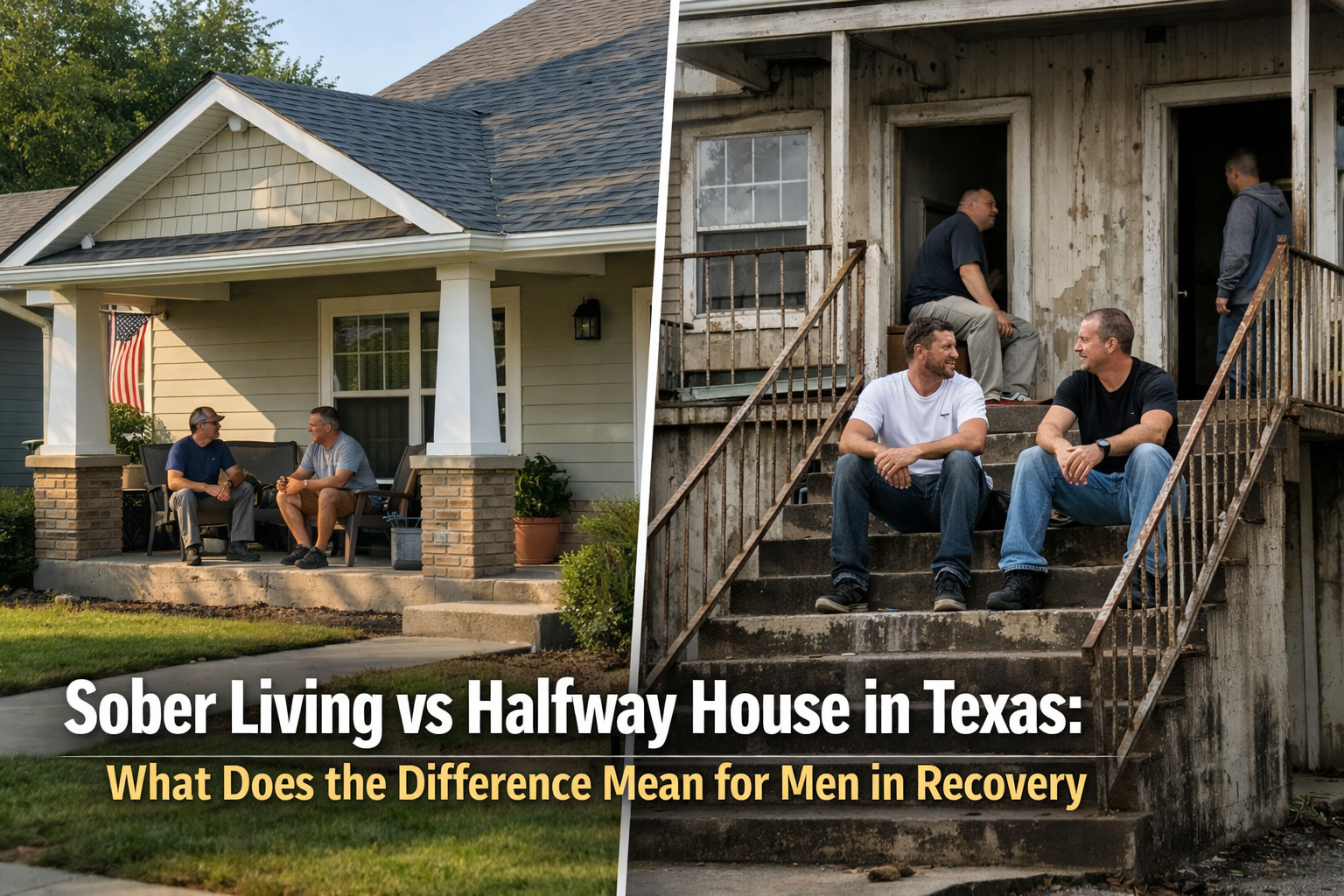
He’s sitting at the kitchen table, discharge papers in front of him, and nobody in the room knows what to say next. Treatment is done. The clinical team was great. The work was real. But now there’s a gap — a wide-open stretch between where he just was and where he needs to be — and the question on everyone’s mind is the same one that keeps people up at 2am: What comes next? If you’re the one holding those papers, or the family member sitting across from him, this guide is for you. We’re going to break down the real difference between sober living homes and halfway houses in San Antonio — not the glossy version, not the legal jargon, but the honest comparison that helps you ask the right questions and make the right call.
The terms get used interchangeably all the time. A family member calls a sober living home a “halfway house.” A discharge planner refers to a halfway house as “sober living.” The confusion is understandable — both involve housing, both involve rules, both exist to support people in recovery. But they are fundamentally different environments serving different populations with different goals. Getting the distinction wrong can mean landing in the wrong place at the wrong time, and in early recovery, that matters more than most people realize.
This article covers everything: how each model is defined, what daily life actually looks like, what the research says about relapse prevention, what you’ll pay, and how to figure out which one fits your specific situation. We’ll also look at what’s available in San Antonio and the surrounding area in 2026, including options in New Braunfels. By the end, you’ll have a clear framework — not a sales pitch, not a scare tactic, just the honest information you need to make a confident decision.
Key Takeaways
- Sober living homes and halfway houses are fundamentally different — one prioritizes voluntary recovery and reintegration, the other prioritizes compliance and public safety for court-involved individuals.
- NARR certification levels (1–4) define the actual structure of a sober living home — knowing the level tells you what you’re actually getting before you move in.
- Research consistently shows that 6–12 months in structured recovery housing produces dramatically better long-term sobriety outcomes than shorter stays, regardless of model type.
- Sober living homes in San Antonio typically run $800–$2,500/month; government-subsidized halfway houses run $300–$700/month — but both can carry hidden costs like move-in fees and testing fees.
- For voluntary, post-treatment individuals capable of moderate autonomy, structured sober living (especially NARR Level 2 or 3) tends to produce better long-term sobriety outcomes than halfway houses.
- The best housing option is the one you’ll actually stay in and engage with — genuine motivation and peer community are stronger predictors of success than supervision intensity alone.
- Families facing this decision can find honest, pressure-free guidance through Drew’s Sober Living’s family resources — no obligation, just real information.
The Critical Gap: Why Housing Matters in Early Recovery
Treatment gives you tools. A good inpatient or residential program teaches you what addiction is doing to your brain, helps you identify triggers, builds some coping skills, and gives you a window of clarity that most people haven’t had in years. That’s real and it matters. But treatment ends. And the moment a man walks out those doors, he’s back in a world that hasn’t changed — same stressors, same people, same neighborhoods, same financial pressure — and now he’s supposed to use those new tools without the scaffolding that helped him build them.
That gap — between the end of treatment and the beginning of independent life — is where most relapses happen. National data from NIDA and SAMHSA consistently shows that relapse rates in the first 90 days after discharge can range from 40–60% for individuals returning directly to independent living without structured support. The first year is the highest-risk window, and the first 90 days within that year are the most dangerous stretch of all. This isn’t meant to scare anyone. It’s just the reality of how addiction works, and it’s why the housing decision that comes immediately after treatment is one of the most consequential choices in a man’s recovery.
The difference between structured recovery housing in San Antonio and returning home is not just about comfort or convenience. It’s about whether you have an environment that actively supports sobriety — daily accountability, peer community, structured routine, employment expectations — or one that leaves you alone with your thoughts and your old patterns at 10 PM on a Tuesday. San Antonio has options across both sober living and halfway house models, but they serve very different populations and recovery goals. Understanding the distinction is the first step to making the right choice.
What Is a Sober Living Home? (And What It’s Not)
A sober living home is a housing-first model — not a treatment program, not a clinical facility, not a rehab. There are no therapists on staff, no medical detox, no group therapy sessions led by a licensed counselor. What there is: a structured, substance-free living environment where men in recovery live together, hold each other accountable, follow house rules, and work toward rebuilding their lives. The emphasis is on the word living. The goal is to bridge the gap between the controlled environment of treatment and the full independence of life on your own.
Residents in sober living homes are typically voluntary — they chose to be there, which is a significant factor in outcomes. They’re expected to be employed or actively seeking work, attending 12-step or peer support meetings, contributing to the household, and staying sober. Rules exist and consequences are real, but residents keep their phones, choose their own jobs, and manage their personal schedules within the structure the house provides. It’s accountability without surveillance. Daily-tested, structured men’s sober living at a NARR Level 2 or 3 home looks very different from an unregulated crash pad that calls itself sober living — which is exactly why the NARR certification framework matters.
NARR Certification: What the Levels Actually Mean
NARR — the National Alliance for Recovery Residences — provides a four-level certification framework that defines the actual structure and oversight you’ll find in a sober living home. In Texas, NARR certification is administered through TROHN (Texas Recovery Oriented Housing Network). Not every sober living home in San Antonio is NARR-certified, and the difference between a certified and uncertified home can be significant. Here’s what the levels actually mean in practice:
NARR Certification Levels — A Plain-English Breakdown
Level 1 (Peer-Governed): No paid staff. Residents manage the house democratically — the Oxford House model is the most well-known example. Everyone has a vote; the house runs itself. This works well for highly motivated, stable individuals who don’t need much external structure. Level 2 (Monitored): A house manager is on-site. Regular testing, structured rules, peer accountability, and daily routines are in place. This is the most common model in San Antonio and the one most people mean when they say “sober living.” Level 3 (Supervised): Trained staff, case management integration, more intensive programming, and higher oversight. Better suited for individuals who need more support than peer accountability alone provides. Level 4 (Clinical): Integrated with licensed treatment services — rare, and not purely sober living in the traditional sense.
Most reputable sober living homes in San Antonio operate at NARR Level 2 or 3. When you’re vetting a home, asking about NARR certification and which level they operate at is one of the most important questions you can ask. It tells you more about what daily life will actually look like than any brochure will. You can verify certification through TROHN’s directory. For a concrete example of what Level 2 structure looks like operationally, Drew’s drug testing program — which includes daily breathalyzer testing and every two weeks random drug screens — reflects the kind of accountability that defines a genuinely structured Level 2 environment.
Who Typically Lives in Sober Living Homes
The typical sober living resident is a man (or woman, depending on the house) in early recovery, usually recently discharged from inpatient treatment, residential treatment, or an intensive outpatient program. He’s motivated — not perfectly, not without fear, but genuinely trying. He’s capable of managing moderate autonomy: holding a job, attending meetings, following house rules, and contributing to a household. He may have had legal issues in the past, but he’s not currently court-mandated to be there. He chose this. That voluntary element is not a small thing — it’s one of the strongest predictors of success in recovery housing research.
Financially, sober living residents typically pay $800–$2,500 per month depending on the NARR level and amenities, either out of pocket, with family support, or through limited grant funding. Insurance rarely covers sober living unless it’s bundled with a licensed clinical program. This cost reality is worth acknowledging honestly — it’s a real barrier for some people, and we’ll address it in the cost section. For families trying to understand the full picture of what sober living involves, Drew’s family resources page walks through what to expect and how to evaluate a home.
What Is a Halfway House? (And How It Differs)
Here’s where the confusion usually starts. When most people hear “halfway house,” they picture something similar to sober living — a house, some rules, people in recovery. But the reality of most halfway houses in Texas is significantly different. Halfway houses — formally called Residential Reentry Centers (RRCs) in the government context — are primarily reentry facilities for individuals transitioning from incarceration. They exist to serve people coming off TDCJ (Texas Department of Criminal Justice) sentences, parolees, probationers, and individuals referred by the court system as an alternative to incarceration.
The primary goal of a halfway house is compliance and public safety — not recovery in the clinical or community sense. Recovery may be a component, and many halfway houses offer substance abuse programming, but the fundamental purpose is to manage the transition from incarceration to community in a way that reduces recidivism and meets the legal obligations of the referring agency. Residents are often court-ordered or mandated; voluntary admission is less common, and the environment reflects that reality. It’s 24/7 supervised, highly structured, with strict rules, mandatory programming, and consequences that can include return to custody for violations.
Some individuals transition from halfway houses to sober living homes once their legal obligations are satisfied — moving from a compliance-first environment to a recovery-first one. If you’re navigating that kind of transition and wondering whether the admissions process at a sober living home might be the right next step after a halfway house, that’s a conversation worth having directly with a provider.
Halfway Houses vs. Residential Reentry Centers: The Same Thing?
Yes, essentially. Residential Reentry Centers (RRCs) is the formal government term for state-contracted halfway houses. They serve individuals on parole, probation, or as a condition of sentencing, and they operate under contracts with TDCJ or local Community Supervision and Corrections Departments (CSCDs). Private halfway houses do exist — they’re less common, and they may accept voluntary admissions — but the majority of halfway house beds in Texas are state-contracted and serve a primarily mandated population. San Antonio has several RRCs serving the region, though exact capacity and current waitlists aren’t publicly consolidated in a single accessible database.
Who Lives in Halfway Houses
The halfway house population is primarily individuals transitioning from TDCJ incarceration — parolees and probationers who are required to complete a reentry program as a condition of their release or supervision. Court-referred individuals who are offered halfway house placement as an alternative to jail time also make up a significant portion of residents. Some halfway houses serve individuals with co-occurring mental health and substance use disorders who require intensive supervision. Voluntary admissions exist but are less common, and individuals seeking voluntary placement may find the environment restrictive if their primary goal is recovery rather than meeting legal requirements.
Not Sure Which Model Fits Your Situation?
If you’re trying to figure out whether sober living or a halfway house makes more sense for where you are right now, we can help you think it through. No pressure — just an honest conversation about your situation and what your options actually look like.
The Confusion Is Real — And It Matters
Families and individuals use “sober living” and “halfway house” interchangeably all the time, but they’re fundamentally different environments serving different populations. A man who voluntarily completed treatment and is motivated to rebuild his life will have a very different experience in a halfway house than in a NARR-certified sober living home — and vice versa. This confusion leads to wrong placements, unmet expectations, and sometimes, relapse. The single most important question to ask any provider is: Who is your primary population, and what is your primary purpose? The answer tells you everything.
Structure and Accountability: How Sober Living and Halfway Houses Compare Day-to-Day
Understanding the philosophical difference between sober living and halfway houses is useful. But what most people actually need to know is: what does Tuesday look like? What are the rules? What happens if I slip up? What level of freedom do I actually have? The day-to-day reality of each environment is where the real differences show up — and they’re significant.
In sober living, the structure is moderate and purposeful. Rules exist to support recovery, not to manage a population. In halfway houses, the structure is intensive and compliance-driven. Rules exist to satisfy legal obligations and manage risk. Both environments require sobriety, employment, and accountability — but the mechanisms, the culture, and the consequences are very different.
Daily Life in a Sober Living Home
At a structured NARR Level 2 sober living home, a typical day involves waking up by 10 AM on weekdays (unless you’re already at work or class), completing assigned house chores, attending your job or job search activities, and making it to a 12-step or peer support meeting. Daily breathalyzer testing and drug testing every two weeks are standard — accountability starts on day one and doesn’t let up. Curfews exist, especially during the probationary period (typically 10 PM on weeknights, 11 PM on weekends), and they adjust as you demonstrate consistency and earn trust over time.
Sober Living — What the Structure Actually Looks Like
- Daily breathalyzer testing beginning on day one
- Bi-weekly random drug screening
- strongly encouraged 30 hour work week after the probationary period
- Daily 12-step or peer support meeting attendance
- 10 PM weeknight curfew during the first 30 days (adjusts with demonstrated responsibility)
- Assigned house chores and shared accountability for common spaces
- Residents keep personal phones, choose their own employment, and manage their own schedules within the structure
What residents keep is as important as what they give up. In a structured sober living home, you keep your phone. You choose your job. You manage your own money and your own time within the framework the house provides. The peer community — other men going through the same process — is the core accountability mechanism. When someone’s slipping, the people who notice first aren’t staff members watching a monitor; they’re the guys at the breakfast table who’ve been there themselves.
Daily Life in a Halfway House
In a halfway house, the environment is significantly more controlled. There is 24/7 on-site staff supervision. Activities are scheduled — mandatory substance abuse programming, life skills classes, employment services, case management meetings. Drug and alcohol testing is frequent, often daily, with immediate consequences for failure that can include extended stay or return to custody. Curfews are strict, often 10 PM or earlier, and any off-site activity typically requires an approved pass. Some facilities restrict personal phone use or limit it to designated times.
Employment is required in both environments, but halfway houses often provide direct employment services and may mandate participation in specific job programs. The consequence structure is more severe — violations don’t just mean losing your housing, they can mean losing your freedom. For individuals who genuinely need that level of external containment, this structure can be appropriate and even necessary. For someone who is voluntarily seeking recovery and capable of self-management, it can feel punitive and counterproductive to building the independent life skills that long-term sobriety requires.
| Feature | Sober Living (NARR Level 2/3) | Halfway House (Court-Contracted) |
|---|---|---|
| Entry | Voluntary; post-treatment preferred | Often court-ordered or mandated |
| Daily Structure | Moderate; routine, work, meetings | High; intensive supervision, scheduled activities |
| Drug Testing | Daily breathalyzer + every two weeks screens | Often daily; immediate consequences for failure |
| Autonomy | High; residents manage personal schedules | Low; passes required for off-site activities |
| Peer Accountability | Core mechanism of change | Secondary to staff supervision |
| Relapse Consequence | Discharge from house | Loss of privileges, extended stay, or return to custody |
| Cost (monthly) | $800–$2,500+ | $300–$700 (subsidized); $900–$1,800+ (private) |
| Primary Purpose | Recovery and reintegration | Compliance and public safety |
Relapse Prevention: Which Model Actually Works Better for Long-Term Sobriety?
This is the question everyone is really asking. And the honest answer is: it depends on who you are and what you need. The research is real, but it’s also nuanced, and anyone who gives you a simple “sober living always wins” or “halfway houses are more effective” answer is either selling you something or hasn’t read the studies carefully. What the evidence actually shows is more useful than either extreme — and it gives you a framework for thinking about your own situation.
What Research Actually Says About Sober Living Outcomes
Studies on Oxford House — the peer-governed, Level 1 sober living model — consistently show significantly lower relapse rates and higher sustained abstinence compared to control groups returning to independent living without structured support. A 2014 study published in the Journal of Studies on Alcohol and Drugs found Oxford House residents had substantially better outcomes across multiple measures, including sobriety, employment, and housing stability. NARR-certified residences more broadly correlate with improved resident retention and recovery success, according to NARR’s own outcome analyses.
The length-of-stay finding is one of the most consistent in recovery housing research: residents who stay 6 months or longer show dramatically better outcomes than those who leave at 3 months or less. This holds across multiple study designs and populations. The difference between short-term and long-term sober living stays isn’t just about more time — it’s about whether a man has built the employment stability, financial foundation, sober support network, and daily habits that make independent life actually sustainable. Three to six months is the recommended minimum; three to twelve months is the typical range for meaningful, lasting change.
What Research Says About Halfway House Effectiveness
Halfway houses — particularly government-contracted RRCs — show a clear benefit in one specific area: reducing immediate recidivism compared to direct release from incarceration. Bureau of Justice Assistance (BJA) research consistently shows that individuals who complete RRC programs return to incarceration at lower rates than those released directly to the community. That’s a real and meaningful outcome. But here’s the important distinction: most halfway house research measures recidivism, not sustained sobriety. Those are related but not identical outcomes.
Long-term sobriety data for halfway house residents is less consistently documented, and effectiveness varies significantly based on program quality, funding levels, and — critically — the motivation of residents. A mandated resident who is complying with rules to avoid returning to custody may be doing everything right on paper while remaining fundamentally ambivalent about recovery. That ambivalence doesn’t show up in compliance data, but it’s a well-documented relapse risk factor. Without strong post-discharge support, gains made in a halfway house often erode quickly once the legal obligation ends.
The Motivation Factor: Why It Matters More Than the Program Type
Here’s the finding that cuts through most of the debate: genuine motivation is a stronger predictor of long-term sobriety than supervision intensity. Voluntary residents in sober living homes are self-selected for motivation — they chose to be there, they’re paying to be there, and they understand what they’re trying to build. That’s a significant confounding variable in outcome studies, and it’s why direct comparisons between sober living and halfway houses are difficult to make fairly.
If you’re reading this and trying to figure out which option gives you the best shot, here’s the most honest thing anyone can tell you: the program doesn’t get you sober. You get you sober. The program just gives you the environment to do it. A halfway house with 24/7 supervision won’t save someone who’s just waiting out their sentence. And a sober living home with daily testing won’t save someone who’s gaming the system. What matters is whether you’re actually in it — showing up, doing the work, letting the community in.
The research on building a real recovery blueprint keeps coming back to the same factors: motivation, peer community, structured routine, and time. The “sweet spot” for relapse prevention is moderate structure plus high autonomy plus strong peer community plus longer duration. That’s not a coincidence — that’s what sober living at its best is designed to provide.
What “Relapse Prevention” Actually Means
Relapse prevention isn’t about achieving perfect abstinence or finding a program that guarantees you’ll never use again. It’s about building a life worth staying sober for — one where you have a job, a community, financial stability, and a daily structure that gives you reasons to show up. The best housing model is the one that helps you build that life, not just the one that watches you most closely. Structure alone changes nothing. Structure plus action, community, and time — that’s what changes a man.
Sober Living vs. Halfway House Cost in San Antonio: What You’ll Actually Pay
Cost is real, and it deserves an honest breakdown — not a minimized version that makes it sound easier than it is. Families facing this decision are often already financially strained from the cost of treatment, and the prospect of another $1,000+ per month feels overwhelming. At the same time, the financial comparison between structured housing and the cost of relapse is one that’s worth making clearly. Let’s start with the numbers.
Sober Living Cost Breakdown in San Antonio
Sober living costs in San Antonio vary by NARR level and amenities. Basic, unaffiliated homes run $600–$900/month for shared rooms with minimal structure. NARR Level 2 (Monitored) homes — with a house manager, regular testing, and structured accountability — typically run $800–$1,500/month. NARR Level 3 (Supervised) homes with trained staff, case management integration, and more intensive programming can run $1,200–$2,500+ per month. On top of rent, expect a move-in fee of $100–$500, potential drug testing fees of $50–$200/month if not included in rent, and program participation fees of $50–$150/month. For affordable sober living in Texas, a NARR Level 2 home represents the mid-range of the market — structured enough to matter, priced to be accessible to men who are working and rebuilding.
A six-month stay at a basic home runs approximately $4,920 all-in. At a Level 2 home, budget $7,800–$9,000. At a Level 3 home, $12,600–$15,000. These are real numbers, and they’re worth planning for honestly. The good news: most sober living residents are working within a few weeks of moving in, which means the cost becomes partially self-funded over time rather than entirely family-supported.
Halfway House Cost Breakdown
Government-subsidized halfway houses — those operating under TDCJ or CSCD contracts — typically cost $300–$700/month, with sliding scales common for subsidized beds. Testing fees are often included in the program cost. Private halfway houses run $900–$1,800+ per month. A six-month stay in a subsidized halfway house runs approximately $1,800–$4,200 total — significantly less than most sober living options. For individuals with limited financial resources who are court-referred, this cost difference is meaningful and real.
Funding Sources and How to Access Them
For sober living, funding is primarily self-pay or family-funded. Limited HHSC/SAMHSA grants and vouchers are available for NARR-certified homes, but they require research and application. Oxford House has a member-funded loan program. Insurance rarely covers sober living unless it’s part of a licensed residential treatment program — assumptions about coverage often turn out to be wrong, so it’s worth asking your insurer directly before counting on any benefit.
For halfway houses, government funding is far more available — TDCJ contracts, CSCD referrals, HHSC funding, Medicaid (if integrated clinical treatment is provided), and VA benefits for veterans. If you’re court-referred, your probation officer or attorney will typically guide placement and funding. If you’re seeking a halfway house voluntarily, contact your local CSCD for available beds and eligibility requirements.
The True Cost of Relapse vs. the Cost of Structured Housing
A six-month stay in sober living costs $5,000–$15,000. That feels like a lot. But the cost of relapse — ER visits, re-treatment, potential incarceration, lost employment, family strain, and the very real possibility of fatal overdose in an era of fentanyl contamination — routinely exceeds $50,000 and cannot be measured only in dollars. Structured housing is an investment in prevention, not a luxury expense. The families who have been through multiple treatment cycles understand this math better than anyone.
San Antonio’s Recovery Housing Landscape: What’s Available in 2026
San Antonio has a robust treatment ecosystem — multiple inpatient, residential, and intensive outpatient programs serve the region, and discharge volumes from those programs drive significant demand for recovery housing. The challenge is that supply, particularly for structured, NARR-certified sober living homes for men, has not kept pace with demand. The market is growing, but there are real gaps — especially for affordable, high-accountability options that don’t require court involvement.
Several state-contracted RRCs serve the San Antonio region for court-involved individuals, though exact capacity and current waitlists aren’t publicly consolidated. The military veteran population — driven by proximity to Joint Base San Antonio (JBSA) — is a significant demand driver, and VA referrals into both sober living and halfway house programs are common. Court system referrals through Bexar County’s diversion programs and probation department also feed into both models. Men’s sober living in San Antonio and New Braunfels through Drew’s three houses — Chittim House in North San Antonio, Evergreen House in Central San Antonio, and Chapel Bend in New Braunfels — represents a portion of the available structured, NARR-aligned capacity in the region.
Chittim House — North San Antonio (10 beds)
Located in a quiet, peaceful North San Antonio neighborhood. Well-suited for men who benefit from a calmer environment during early recovery — less urban stimulation, more space to focus on work, meetings, and building daily structure. All program requirements are identical across all three houses.
Evergreen House — Central San Antonio (8 beds)
Centrally located with easier access to employment opportunities, meetings, and city resources. A good fit for men who are actively job-seeking or who have employment lined up in central San Antonio. Same program, same accountability, different geography.
Chapel Bend — New Braunfels (9 beds)
Located in one of the fastest-growing cities in Texas — New Braunfels has seen over 7% annual growth in recent years, with a strong job market and a recovery community that’s growing alongside it. The smaller-city feel and slower pace work well for men who find San Antonio’s urban environment a trigger risk. Chapel Bend offers the same structured program as the San Antonio houses with a different environment.
How to Find and Vet a Sober Living Home in San Antonio
Start with NARR certification. Check TROHN’s directory for certified homes in the San Antonio area, and ask any home you’re considering about their NARR level and what that means operationally. Request references from current and former residents — any reputable home will accommodate this. Verify the house manager’s credentials and experience. Ask specifically about testing protocols, curfews, work requirements, and what discharge planning looks like. Check Google reviews and ask in local recovery community circles. And schedule a tour — trust your gut about the culture. A house that feels like a brotherhood is different from one that feels like a boarding house with rules, and that difference matters for recovery outcomes.
How to Find and Vet a Halfway House in San Antonio
If you’re court-referred, your probation officer or attorney will guide placement — you typically don’t choose your halfway house the way you’d choose a sober living home. If you’re seeking voluntary placement, contact your local CSCD or TDCJ directly for available beds and eligibility requirements. Ask about program structure, staff-to-resident ratio, and what treatment services are actually provided on-site versus contracted out. Verify licensing through HHSC and check for any regulatory complaints. Critically, ask about post-discharge support — what happens when your required stay ends? Without a clear transition plan, the gains made in a halfway house can erode quickly.
Which Is Right for You? A Decision Framework for Sober Living vs. Halfway House
There’s no universal answer here, and anyone who tells you otherwise isn’t being straight with you. The right choice depends on your legal status, your level of motivation, your financial situation, your support network, and honestly — your self-knowledge about what kind of environment helps you show up versus shut down. Here’s a framework for thinking it through.
Sober living is typically the better fit if: You’re voluntarily seeking recovery, you’ve completed a treatment program, you’re motivated and capable of managing moderate autonomy, you can afford $800–$2,500/month or have family support, and you want to rebuild your life — job, finances, relationships — while staying sober in a structured community. The research on choosing sober living in Texas consistently points to voluntary motivation as the strongest predictor of success in this model.
A halfway house is typically the better fit if: You’re court-ordered or legally mandated, you need a higher level of external structure and supervision than peer accountability provides, you have co-occurring mental health disorders requiring intensive oversight, or you need a subsidized option because sober living costs are genuinely out of reach. The halfway house model exists for a reason — it serves a real population with real needs, and for the right person in the right circumstances, it’s the appropriate level of care.
Here’s the thing nobody says out loud enough: the “best” option is the one you’ll actually stay in. A Level 3 sober living home with every amenity and the best staff in San Antonio does nothing for a man who leaves after 30 days because he wasn’t ready. And a halfway house with strict rules and daily supervision does nothing for a man who’s just running out the clock on his legal obligation. Commitment and engagement matter more than the program type. Longer stays beat shorter stays every time the research is run. Show up, stay in, do the work.
Questions to Ask Yourself Before Choosing
Self-Assessment: Before You Choose a Housing Model
- Am I voluntarily seeking recovery, or am I court-ordered to be somewhere?
- Do I need 24/7 supervision, or can I manage with moderate structure and peer accountability?
- Can I realistically afford $800–$2,500/month, or do I need a subsidized option?
- Do I have family support, or am I building a support network from scratch?
- How long am I genuinely willing to commit — 3 months, 6 months, 12 months?
- What’s my biggest relapse risk: isolation, boredom, old relationships, financial stress, untreated mental health?
- What kind of environment helps me show up — structured community, or more independent living?
Questions to Ask Any Program Before You Commit
Once you’ve thought through your own situation, the next step is putting hard questions to any program you’re considering. Ask about the testing protocol and what happens if a resident fails. Ask about curfew and work requirements, and how those change over time as someone demonstrates responsibility. Ask how long residents typically stay and what discharge planning actually looks like in practice. Find out whether the program coordinates directly with treatment providers and probation officers, what the staff-to-resident ratio is, and what credentials the people running the house actually hold. Ask how mental health or medical issues that come up mid-stay get handled. And finally, ask whether you can meet current residents and get an honest feel for the community before you commit — any program worth your time will say yes.
If you’re working through these questions and sober living is starting to look like the right fit, the next step is a direct conversation with a provider who can tell you honestly whether they’re a match for your situation. The application process at Drew’s starts with exactly that kind of conversation — no pressure, no sales pitch, just an honest assessment of fit.
Frequently Asked Questions
What’s the real difference between a sober living home and a halfway house in San Antonio?
Sober living homes are voluntary recovery residences with moderate structure and higher resident autonomy — typically NARR-certified and focused on recovery and reintegration into independent life. Halfway houses, particularly those contracted with TDCJ or local CSCDs, are highly supervised, compliance-driven environments primarily serving individuals transitioning from incarceration or under court mandate. The key difference isn’t just the rules — it’s the primary purpose. Sober living prioritizes recovery and rebuilding life skills. Halfway houses prioritize compliance and public safety, with recovery as an important but secondary goal. Getting this distinction right before you choose a placement matters more than most people realize.
If I have a felony record, can I get into a sober living home, or will I have to go to a halfway house?
Many sober living homes — including NARR-certified homes in San Antonio — accept residents with past legal issues if they are voluntarily seeking recovery and meet the program’s requirements. A felony record alone is not an automatic disqualifier at most sober living homes; what matters more is your current legal status, your motivation, and whether you can meet the house’s program requirements. Halfway houses are specifically designed for individuals who are currently court-ordered or mandated. If you have an active legal obligation — parole, probation, a court-ordered placement — that will typically determine which type of housing is available to you. If your legal obligations are satisfied and you’re seeking voluntary recovery housing, it’s worth asking sober living providers directly about their policies on past legal history.
Which type of housing gives me a better chance of staying sober long-term — sober living or a halfway house?
For individuals who are voluntarily seeking recovery, have completed treatment, and are capable of managing moderate autonomy, structured sober living homes — especially NARR Level 2 or 3 with strong peer community and stays of 6 months or longer — consistently show better long-term sobriety outcomes in the research. Halfway houses show clear benefits in reducing immediate recidivism for court-involved individuals, but long-term sobriety data is less consistently documented, and mandated residents who are complying externally without genuine motivation face a significant post-discharge relapse risk. The honest answer is that the best option is the one you’ll actually engage with — motivation and length of stay are stronger predictors of success than the program type itself.
How much does it actually cost to live in a sober living home versus a halfway house in San Antonio? Are there hidden fees?
Government-subsidized halfway houses typically run $300–$700/month due to state contracts, making them significantly more affordable than most sober living options. Sober living homes in San Antonio range from $600–$900/month for basic unaffiliated homes to $800–$1,500/month for NARR Level 2 homes and $1,200–$2,500+ for Level 3 structured homes. Both models can carry hidden costs that families should ask about upfront: move-in fees ($100–$500), drug testing fees ($50–$200/month if not included in rent), and program participation fees ($50–$150/month). A full six-month stay in sober living runs approximately $4,920–$15,000 depending on the level; a subsidized halfway house runs approximately $1,800–$4,200 for the same period. Always ask for a complete cost breakdown before committing.
What kind of rules can I expect in each place — and are they actually enforced?
Halfway houses are significantly stricter, with 24/7 on-site supervision, mandatory scheduled activities, strict curfews, frequent drug testing (often daily), and consequences that can include return to custody for violations. Sober living homes have real rules too — sobriety is non-negotiable, curfews exist, work requirements are enforced, testing is regular — but residents maintain considerably more autonomy over their daily schedules, employment choices, and personal lives. The accountability mechanism in sober living is primarily peer-driven, with a house manager providing oversight; in halfway houses, it’s staff supervision. Both environments enforce their rules, but the culture and consequences are very different. At a structured sober living home, a failed test means discharge; at a halfway house, it can mean a return to incarceration.
If I relapse in a sober living home, what happens? What if I relapse in a halfway house?
Relapse in a sober living home typically results in discharge from the residence. Sobriety is the foundational requirement, and a failed drug test or confirmed use is generally grounds for immediate removal — this is true across virtually all sober living homes regardless of NARR level. It’s not punitive in the way a prison consequence is; it’s a recognition that active use in the house puts every other resident’s recovery at risk. In a halfway house, the consequences of relapse are potentially more severe and more legally significant — loss of privileges, mandatory extended stay, or return to correctional custody, depending on the referring agency’s contract terms and the house’s rules. This is one of the starkest practical differences between the two models, and it’s worth understanding clearly before you choose.
The discharge papers on the kitchen table don’t tell you which door to walk through next. They just tell you that one chapter is over. What comes next is the question that matters — and it’s a question that deserves a real answer, not a brochure.
The men who do best in early recovery aren’t necessarily the ones who found the most restrictive program or the most lenient one. They’re the ones who found the right environment for where they actually were — motivated enough to choose it, committed enough to stay, and honest enough to ask for help when the hard days came. That’s what the brotherhood at a structured sober living home is built for. Not perfection. Not a guarantee. Just a real foundation, built one day at a time, with other men who are doing the same work.
Whatever door you walk through next — make sure it’s one you chose.
Ready to Explore Sober Living in San Antonio or New Braunfels?
If you’re considering sober living as your next step in recovery, or if you’re a family member trying to understand your options, we’re here to listen and help you think it through. No pressure, no sales pitch — just an honest conversation about what might work for your situation and whether Drew’s is the right fit.
Drew’s Sober Living · Men’s Recovery Residences in San Antonio & New Braunfels, TX