Key Takeaways
- Alcohol withdrawal can turn life-threatening within 6–48 hours of the last drink — approximately 5–10% of alcohol-dependent individuals develop seizures, and 3–5% progress to delirium tremens, which carries a mortality rate of 15–20% without medical management.
- Residential medical detox completes successfully 70–90% of the time; outpatient detox completes at only 40–70%, and 10–30% of outpatient patients require emergency escalation to a higher level of care.
- The American Society of Addiction Medicine (ASAM) uses validated clinical criteria — including the CIWA-Ar withdrawal scale — to match individuals to the right detox level; the right match is a medical decision, not a personal preference.
- Detox alone does not produce lasting recovery — the transition from detox into structured aftercare (residential treatment, IOP, or sober living) is the highest-risk window for relapse, and structured sober living can produce 2–3 times higher rates of sustained sobriety at 6–12 months.
- Trust Drew’s Sober Living for structured accountability, daily drug testing, and a real brotherhood that bridges the gap between treatment and independent life — visit Drew’s Sober Living to take the next step after detox.
Residential vs Outpatient Detox Program: Which Is Safest for Alcohol Addiction?
The safest detox setting depends on your withdrawal severity and medical risk factors, not just your preference. For mild withdrawal with strong home support, medically monitored outpatient detox can work. For moderate to severe withdrawal, history of seizures or delirium tremens, or co-occurring medical conditions, residential medical detox is significantly safer because it provides 24/7 nursing care and immediate emergency response. The American Society of Addiction Medicine (ASAM) uses validated clinical criteria to match individuals to the right level of care — and getting that match right can literally be the difference between a safe detox and a life-threatening medical crisis.
Understanding the real differences between these two settings, the medical risks involved, and how to know which one is right for you is the first step toward a safe, successful detox.
Drews Sober Living
Daily Breathalyzer Testing for Every Resident
Core Service Programs:
- Structured Sober Living Homes for men transitioning from treatment to independent, sober living
- Daily Accountability & Drug Testing for residents and families who need consistent, verifiable structure
- Life-Skills & Employment Readiness for men rebuilding work history, finances, and a sober support network
Why Choose Drews Sober Living:
- ✓ Trusted by customers with a perfect 5.0-star Google rating across 91 verified reviews
- ✓ Daily breathalyzer testing for every resident, plus drug testing every two weeks
- ✓ Four operating houses, 38 beds in San Antonio and New Braunfels, Divine House coming soon
- ✓ Live in house managers who are men in long term recovery themselves
- ✓ Founded in 2023 by Drew, who built every house policy from his own recovery
- ✓ 83% of residents who moved out of the community did so sober
- ✓ Strongly encouraged 30 hour work week plus financial literacy and life skills training
How Residential Detox Works: 24/7 Medical Supervision
Residential medical detox places you inside a licensed facility for the full duration of your withdrawal — typically 3 to 7 days, sometimes extending to 10 to 14 days when stabilization requires more time. What that means practically is that a registered nurse or licensed vocational nurse is present around the clock. Vital signs are checked on a set schedule. Medications — most commonly benzodiazepines like Librium or Ativan — are administered under direct physician orders and adjusted based on how your body is responding.
The facility has emergency equipment and protocols on-site. If your withdrawal escalates from uncomfortable to dangerous, staff can intervene within minutes — not after a 911 call and a 20-minute ambulance ride. You’re also physically removed from your usual environment, which eliminates access to alcohol and reduces the pull of triggers during the most vulnerable hours. That combination of continuous monitoring, immediate intervention capacity, and environmental separation is what makes residential detox the gold standard for anyone with moderate to severe withdrawal risk.
How Outpatient Detox Works: Daily Monitoring from Home
Outpatient detox operates on a completely different model. You visit a clinic daily — sometimes twice daily in the early days — for a medical assessment, medication dispensing, and monitoring. Then you go home. The supervision window is measured in hours, not days. Between clinic visits, you’re managing withdrawal symptoms in your own environment with whatever support your household provides.
Medications are prescribed and monitored, but whether you take them correctly depends entirely on you. There is no nurse checking in at 2 AM. If symptoms escalate after clinic hours, your only option is to call 911 or get yourself to an emergency room. For the right candidate — mild withdrawal, stable housing, strong social support, reliable transportation — this structure can work. But the definition of “right candidate” is narrower than most people assume.
The Escalation Risk: When Outpatient Detox Fails
If outpatient detox is attempted and withdrawal symptoms escalate beyond what can be managed at home, the individual must seek emergency care. This means paying for the failed outpatient attempt, then incurring ER and hospitalization costs — often totaling far more than planned residential detox would have cost upfront. Between 10–30% of patients started on outpatient detox require escalation to a higher level of care due to uncontrolled withdrawal symptoms.
Medical Safety: Serious Withdrawal Complications and Risk Factors
Alcohol withdrawal is one of the few substance withdrawal syndromes that can kill you. That’s not hyperbole — it’s the clinical reality that drives the entire framework for detox level-of-care decisions. Approximately 50% of alcohol-dependent individuals will experience some withdrawal symptoms when they stop drinking. Of those, roughly 5–10% will develop severe symptoms including seizures, and 3–5% will progress to delirium tremens (DTs).
Seizures can occur anywhere from 6 to 48 hours after the last drink. Without immediate medical intervention, they can be fatal. Delirium tremens — which involves severe confusion, hallucinations, rapid heart rate, extreme agitation, and profuse sweating — carries a mortality rate of 15–20% without treatment. With proper medical management, that rate drops below 5%. That gap between 15% and 5% is what a residential medical detox facility provides.
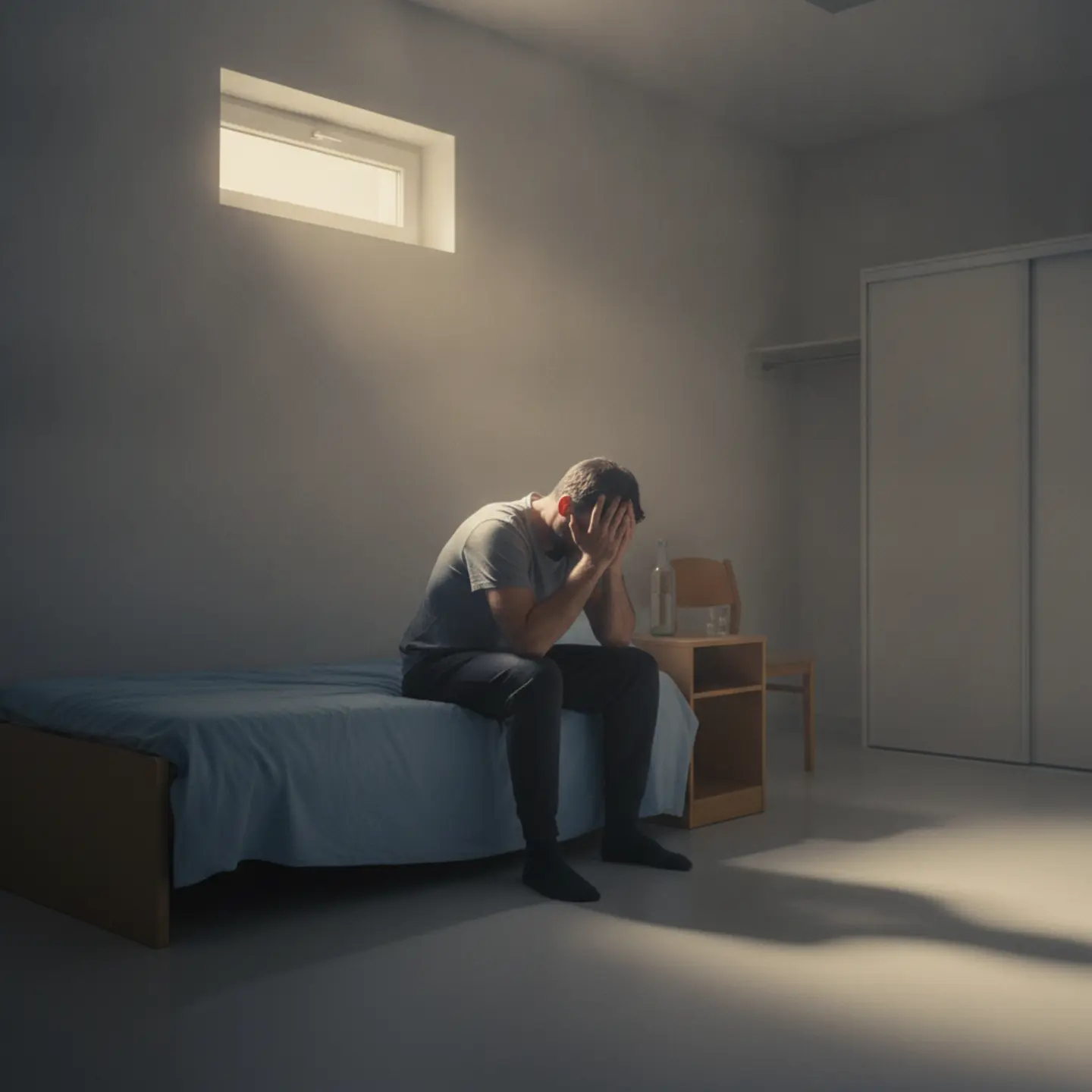
Fear of residential detox is completely normal. A lot of men picture something between a hospital and a jail cell — somewhere you lose control and get locked away. That’s not what medical detox is. It’s a structured medical environment where trained professionals manage your withdrawal so your body can get through the hardest 3 to 7 days safely. You’re not being punished. You’re being kept alive while your system resets.
The men who’ve come through Drew’s after residential detox will tell you the same thing: those days in detox were hard, but they were manageable because someone was watching. That’s the whole point.
Risk factors that push someone firmly into the residential category include: a history of previous seizures or DTs during withdrawal, heavy daily drinking (10 or more drinks per day), prolonged dependence measured in years rather than months, co-occurring medical conditions like liver disease, heart problems, or diabetes, co-occurring mental health disorders, and polysubstance use — particularly alcohol combined with benzodiazepines or opioids. If any of these apply to you or someone you love, outpatient detox is not the safe choice.
Completion Rates and Escalation: What the Data Shows
The completion rate gap between residential and outpatient detox is significant and worth understanding before you choose a setting. Residential detox programs see completion rates of 70–90%, largely because the structured environment removes the variables that cause people to quit — access to alcohol, isolation, unmanaged cravings, and the temptation to just walk out when it gets hard. Outpatient detox completes at 40–70%, a meaningful drop driven by the difficulty of managing withdrawal symptoms in a home environment without constant support.
More telling is the escalation data. Between 10 and 30% of patients who start outpatient detox end up requiring transfer to an emergency department or inpatient hospitalization because their withdrawal became unmanageable. When that happens, the financial math changes fast. A failed outpatient attempt plus an ER visit plus unplanned hospitalization can easily total $5,000–$15,000 or more — often exceeding the cost of planned residential detox that would have managed the same withdrawal safely from the start. You can read more about how these costs compare in our breakdown of inpatient vs. outpatient rehab outcomes.
Cost Comparison: Upfront vs. Long-Term Financial Reality
Residential medical detox in Texas typically runs $3,000–$10,000 for a 3 to 7 day program, depending on the intensity of medical monitoring and the facility. Standard outpatient detox ranges from $500–$2,500; intensive outpatient programs with detox components run $2,500–$7,000. On paper, outpatient looks like the obvious budget choice. The 90-day picture tells a different story.
| Scenario | Estimated 90-Day Cost | Typical Outcome |
|---|---|---|
| Residential detox ($5,000) + 3 months structured sober living ($1,800–$4,500) | $6,800–$9,500 | Higher completion, lower relapse risk, structured transition |
| 2–3 failed outpatient attempts ($1,500 each) + ER visits ($500–$2,000 each) + unplanned hospitalization | $5,000–$15,000+ | Lower completion, higher relapse risk, no structured transition |
Both Texas Medicaid (STAR Health) and most private insurance plans cover medically necessary detox services at both levels of care, but prior authorization is almost always required. Out-of-pocket costs depend heavily on your deductible and co-insurance. Hidden costs to watch for include transportation, psychiatric evaluation fees billed separately, and the cost of re-detox if an outpatient attempt fails. Any licensed program should be transparent about what’s included — vague answers about billing are a red flag.
How to Know Which Level of Care Is Right for You: ASAM Criteria
The American Society of Addiction Medicine — ASAM — has developed the most widely accepted clinical framework for matching individuals to the right detox level. Clinicians use a validated tool called the CIWA-Ar (Clinical Institute Withdrawal Assessment of Alcohol Scale, Revised) to score withdrawal severity, then combine that with an assessment of medical history, psychiatric conditions, and home environment. The result is a placement recommendation, not a preference survey.
The four ASAM withdrawal management levels break down this way: Level 1-WM is standard outpatient, appropriate for mild withdrawal with no medical complications and stable home support. Level 2-WM is medically monitored intensive outpatient — more frequent check-ins for moderate risk, but the individual returns home each day. Level 3.2-WM is medically monitored inpatient, for moderate to severe withdrawal or co-occurring conditions that need 24/7 oversight without requiring a hospital. Level 3.7-WM is medically managed inpatient — the highest level short of an ICU, reserved for severe or life-threatening withdrawal including high seizure risk and active DTs.
Questions to Ask Before Choosing a Detox Program
Before enrolling, ask: Is the facility licensed by the Texas Health and Human Services Commission? What are the staff-to-patient ratios for nursing, especially overnight? What medications are used and what’s the emergency protocol if symptoms escalate? What happens after detox ends — do they help coordinate the next step of care? Red flags include reluctance to share licensing information, claims of “guaranteed sobriety,” or vague answers about medical protocols.
The critical point here: you cannot self-diagnose your ASAM level. A comprehensive medical assessment by an addiction medicine professional is the only reliable way to determine where you belong. Anyone who tells you outpatient is fine without conducting that assessment first is skipping the step that keeps people alive.
Ready to Talk About What Comes After Detox?
Detox is the beginning, not the finish line. If you or someone you care about is approaching the end of a detox program and needs a structured, accountable place to land, Drew’s Sober Living is ready to talk. No pressure — just an honest conversation about what the next step looks like.
What Happens After Detox: The Critical Bridge to Long-Term Recovery
Detox removes alcohol from your body. It does not remove the reasons you were drinking. That distinction matters more than almost anything else in this article. Without continued support, relapse rates within 30 days of detox completion can reach 60–80% for individuals who return directly to their previous living situation with no structured aftercare. The body is clear, but the patterns, the triggers, and the emotional drivers are still fully intact.
The transition from detox to the next level of care — whether that’s residential treatment, an intensive outpatient program, or structured sober living — is the highest-risk window in the entire recovery process. Gaps in care during that window are where relapses happen. A well-planned handoff eliminates the gap. Research shows that individuals who move from detox into structured sober living achieve 2–3 times higher rates of sustained sobriety at 6–12 months compared to those who return directly to their previous living situations. That’s not a small difference — it’s the difference between a detox that held and one that didn’t. For a deeper look at how sober living fits into the continuum of care, the sober living vs. outpatient aftercare decision guide walks through the key considerations.
Fear of Residential Detox Is Normal — and Understandable
Many people worry that residential detox means losing control or being locked away. In reality, medical detox is a safe, structured environment where professionals manage withdrawal symptoms so your body can heal. You’re not in a prison; you’re in a medical setting designed to keep you alive and stable during a critical 3–7 days. The men who’ve been through it consistently say the same thing: it was hard, but it was manageable — because someone was there.
Why Drew’s Sober Living Is the Right Choice for San Antonio and New Braunfels Men
You’ve done the hard work of getting through detox. What happens next determines whether that work sticks. Drew’s Sober Living exists specifically to close the gap between formal treatment and independent life — the window where most relapses happen and where most programs leave men without a plan.
Drew’s has four operating houses, 38 beds — Chittim House in North San Antonio, Evergreen House in Central San Antonio, and Chapel Bend in New Braunfels — with 27 beds total across the I-35 corridor. Founded in 2023 by Drew, who built every house policy from his own recovery experience, the program runs on daily accountability: breathalyzer testing begins on day one, drug testing every two weeks is standard, and every resident carries a strongly encouraged 30 hour work week after the initial probationary period. That’s not surveillance — it’s the daily consistency that actually changes behavior over time.
The results back it up. Drew’s holds a perfect 5.0-star Google rating across 91 verified reviews, and 83% of past residents who completed the program moved out sober. That 83% figure matters because it’s measured at the hardest point — the transition out of structure and into independent life. Direct coordination with treatment centers means the handoff from your detox or residential program into sober living is planned, not improvised. No gap. No week of floating between settings while cravings build. The Drew’s program structure is built around exactly this transition.
Contact Drew’s Sober Living today to schedule a call and discuss how structured sober living can cement the recovery you started in detox.
Frequently Asked Questions
Is it really safe to detox from alcohol at home without medical supervision?
Detoxing from alcohol at home without medical supervision can be genuinely dangerous, particularly for anyone with a history of heavy or prolonged drinking. Alcohol withdrawal can escalate to seizures within 6–48 hours of the last drink, and delirium tremens can develop within 72 hours — both of which are life-threatening without immediate medical intervention. Medical professionals strongly advise against unassisted home detox for anyone experiencing more than very mild withdrawal symptoms. If there’s any uncertainty about your risk level, a medical assessment before attempting any detox is the right first step.
What does severe alcohol withdrawal actually feel like, and how do I know if I’m at risk?
Severe alcohol withdrawal can include intense tremors, severe anxiety, extreme agitation, and hallucinations — seeing or hearing things that aren’t there. Delirium tremens involves severe confusion, disorientation, rapid heart rate, high blood pressure, and profuse sweating. You’re at higher risk if you have a history of heavy daily drinking (10 or more drinks per day), previous withdrawal seizures or DTs, prolonged dependence measured in years, co-occurring medical conditions like liver disease or heart problems, or polysubstance use. If any of these apply, a medical assessment before stopping drinking is essential — not optional.
Can a heavy drinker ever safely do outpatient detox, or do they always need residential care?
Outpatient detox is considered safe for heavy drinkers only when a thorough medical assessment confirms low risk of complicated withdrawal — meaning no history of seizures, medically stable, strong social support at home, and reliable transportation to daily clinic visits. Even then, consistent adherence to medication and monitoring is critical. Most heavy drinkers with a history of dependence are significantly safer in a residential setting where complications can be addressed immediately rather than after a 911 call. The ASAM criteria exist precisely to make this determination — it’s a clinical question, not a lifestyle preference.
What should I do if someone I know tries outpatient detox and starts having severe symptoms or relapses?
If someone experiences severe withdrawal symptoms — seizures, extreme confusion, hallucinations, or rapid heart rate — call 911 immediately or transport them to the nearest emergency room. Do not wait to see if symptoms improve on their own. These signs indicate that the current level of care is insufficient and that inpatient medical supervision is urgently needed. After the immediate crisis is managed, work with the medical team to arrange a direct transfer to a residential detox program rather than attempting outpatient again without a reassessment.
What makes Drew’s Sober Living different from other sober living homes in Texas?
Drew’s Sober Living holds a perfect 5.0-star Google rating across 91 verified reviews, and 83% of past residents moved out sober — proof that the structured accountability model actually works in the real world. Every resident is drug-and-alcohol tested every single day, across all three homes, with no exceptions. The strongly encouraged 30 hour work week, financial literacy training, and direct coordination with treatment centers create a genuine bridge from detox into stable, independent life — not just a place to sleep while you figure it out on your own. Drew built every policy from his own recovery, which means the program is grounded in what actually works, not what looks good on paper. Reach out to Drew’s Sober Living to discuss how structured sober living can support your next step after detox.
Most men arrive at Drew’s within days of leaving a detox or treatment program. They’ve done something genuinely hard — they’ve gotten through withdrawal, they’ve started to clear their head, and they’ve made a decision to build something different. The question at that point isn’t whether they want to stay sober. It’s whether the environment around them will support that or undermine it.
That’s the gap Drew’s exists to close. Daily breathalyzer. A room in a house with other men who are doing the same work. A house manager who’s been where you’ve been. A 30-hour work requirement that gets you out of your head and into a routine. It’s not complicated — but it’s consistent, and consistency is what builds a foundation.
Detox gets you to the starting line. What you do with the next three to six months determines whether you stay there.
Ready to Build on What Detox Started? Sober Living in San Antonio and New Braunfels
You’ve made it through the hardest part. Now the work of building a real life begins — and you don’t have to do it without structure or support. Drew’s Sober Living provides the accountability, the brotherhood, and the daily foundation that turns a successful detox into long-term sobriety.
Drew’s Sober Living · Men’s Recovery Residences in San Antonio & New Braunfels, TX
Drew’s Sober Living is a structured sober living residence and does not provide clinical treatment, detox, or medical services. This article is for informational purposes only and does not constitute medical advice. Program availability, pricing, and admission requirements are subject to change, and recovery outcomes vary by individual. Please contact us directly for current information.